
Table of Contents


Order once. Track every device to retirement.
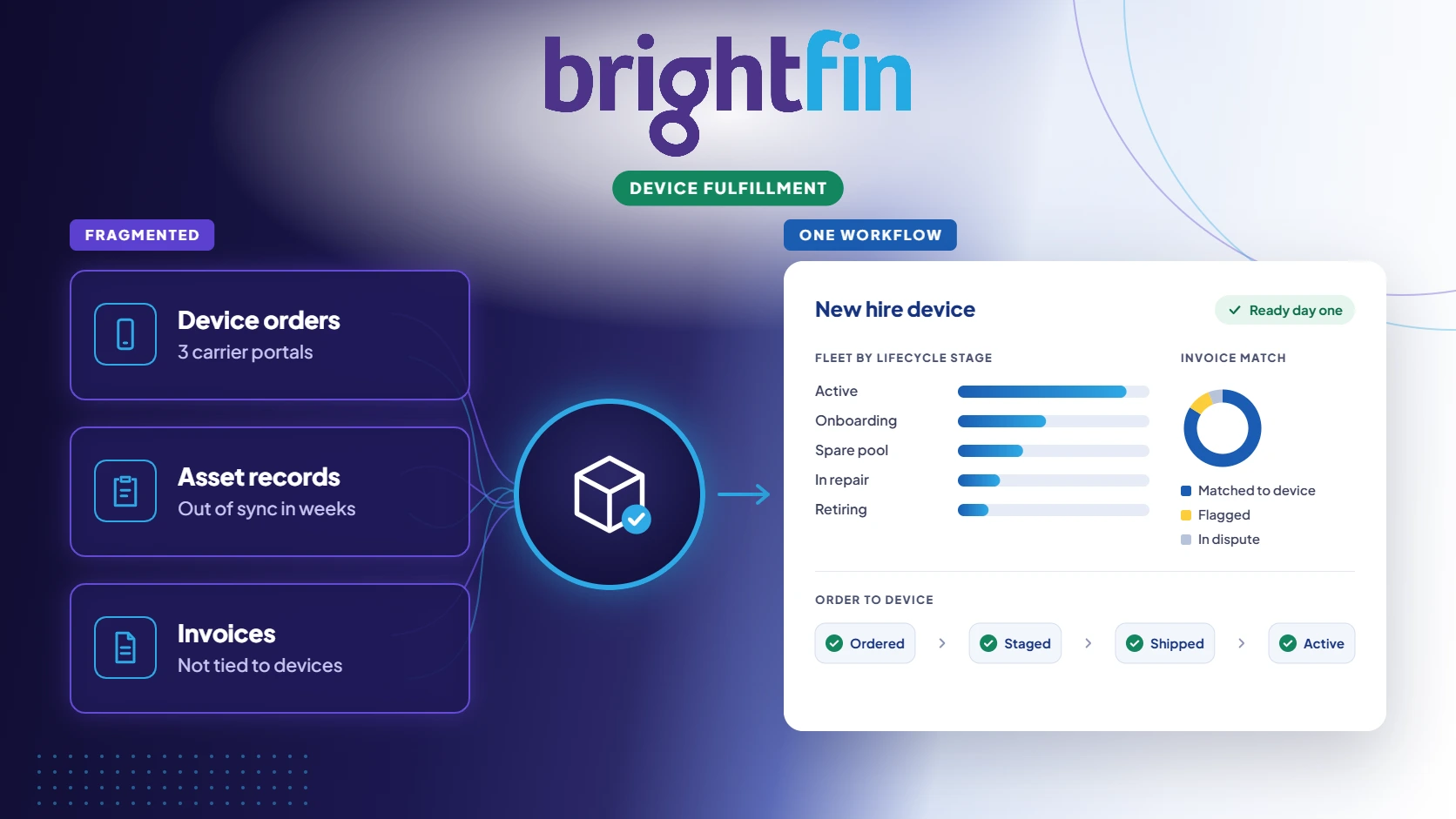
A new hire starts Monday. Her laptop is imaged and waiting. Her phone is an order number in a carrier portal nobody checked on Friday.
That’s how most enterprise mobility programs break down. They don’t lack features. Ordering, provisioning and lifecycle tracking just live in systems no single team controls. Orders go through one portal, invoices arrive through another, and asset records drift out of sync within weeks.
If you run a fleet of thousands of corporate devices, you know the cost: late deployments, contested invoices and analysts reconciling spreadsheets instead of cutting spend. Brightfin built its mobility management software to fix that inside ServiceNow.
This guide compares five platforms on what matters for automated device fulfillment and lifecycle control, with a comparison table and a checklist for your shortlist.
Quick guide: 5 best mobility management software for device fulfillment
- Brightfin Mobility Management: Best overall. Ordering, provisioning, lifecycle tracking and expense control in one platform, built natively on ServiceNow.
- Tangoe: Multi-domain expense management with carrier invoice processing for mixed telecom and mobile environments.
- Sakon: Cloud-based technology expense management with data normalization for invoice accuracy across carriers.
- Calero: Expense management for organizations consolidating unified communications, voice, data and mobile billing.
- Cass Information Systems: Outsourced telecom and mobility invoice processing and payment.
How we chose these platforms
Feature lists don’t tell you how many hands touch a device before it reaches an employee. We scored each platform on six operational questions IT leaders ask about large fleets.
- Automated device provisioning. Can you order, stage, configure and deploy a device in one workflow, without switching portals?
- Lifecycle tracking. Do asset records stay accurate from procurement through active use, repair and retirement? Accurate records stop you paying for devices no longer in service.
- Carrier integration and eBonding. Does the tool connect directly to carrier systems for orders, plan changes and invoices? eBonding is a direct system-to-system link that replaces email and portal re-keying.
- Expense visibility and cost allocation. Can you tie every invoice line to a device, a user and a cost center? That turns a billing report into a financial control.
- Platform integration. Does it work inside your IT service management (ITSM) and IT asset management (ITAM) tools, or add another silo?
- Managed services. Does the vendor handle disputes, plan optimization and end-user help desk, so your team doesn’t have to?
1. Brightfin Mobility Management: Best overall for device fulfillment
Most fleets struggle because device data, expense data and workflow data live in separate systems. Brightfin closes that gap. Procurement, provisioning, asset tracking, invoice processing and cost optimization run in one platform, built 100% natively on ServiceNow.
When a new employee needs a device, Brightfin runs the whole lifecycle. It places the order through carrier eBonding, stages and kits the device with your apps loaded, routes approvals, and tracks the asset in your ServiceNow configuration management database (CMDB). Every device record reflects reality, not the last manual update.
Orders, plan changes and activations flow through API-based workflows instead of email threads. Invoices are audited automatically, so discrepancies are flagged before they become disputed charges. Cost allocation works at the device and user level, tied to departments and cost centers.
Brightfin’s managed mobility services cover procurement, fulfillment, unified endpoint management (UEM) administration, 24×7 help desk and reverse logistics. Your team works on strategy instead of ticket queues.
160,000 devices, one source of truth. Siemens runs more than 160,000 mobile devices. It used Brightfin Sync to replace fragmented regional portals with one record of every device in ServiceNow, and Brightfin Order to give employees worldwide one self-service portal for new devices.
Named by Gartner. Awarded by ServiceNow, twice. Gartner named Brightfin a Representative Vendor in its 2026 Market Guide for Managed Mobility Services, and Brightfin is a ServiceNow Elite Partner (Build).
What it does
- Carrier eBonding. API links to carriers handle orders, plan changes and activations, cutting manual purchasing steps and fulfillment time.
- Staging, kitting and deployment. Devices arrive with your security policies, mobile device management (MDM) profiles and apps installed. Employees start work on day one, not setup.
- Native ServiceNow data model. Every asset, invoice and workflow lives in ServiceNow’s own tables, with no sync lag or reconciliation errors.
- Invoice auditing and disputes. Invoices are checked against contracts and billing errors flagged automatically, so finance gets clean, auditable data.
- Reverse logistics and recycling. Returns, data wiping and responsible recycling at end of life, with trade-in value recovered.
- 24×7 end-user help desk. Employees call for mobility support directly, so your IT team handles fewer tickets.
Pros
- Full device lifecycle, from procurement to retirement, inside ServiceNow.
- Carrier eBonding automates orders and plan changes.
- Managed services cover UEM administration, help desk and reverse logistics.
Good to know
- Built for ServiceNow shops. Organizations not yet on ServiceNow should plan that platform decision first.
- Migration is scoped up front. Legacy asset records are mapped to ServiceNow’s native tables before go-live, so data lands clean.
- Allocation fits your books. Cost allocation models are configured to your financial structure, so reports match how finance already works.
2. Tangoe: Multi-domain expense management
Tangoe offers technology expense management across mobile, fixed telecom and cloud. Its strength is invoice processing and spend analytics, useful if your main goal is pulling billing data from many carriers into one reporting view. It includes carrier invoice ingestion, spend dashboards and dispute workflows.
What it does
- Multi-carrier invoice processing. Ingests and normalizes invoices from multiple carriers for analysis and allocation.
- Spend analytics. Dashboards show mobile and telecom spend by department, location and carrier.
- Dispute workflows. Flags and tracks billing disputes with carriers.
Pros
- Covers mobile, fixed telecom and cloud in one platform.
- Ingests invoices from a wide range of carriers.
- Dashboards give multi-domain spend visibility.
Cons
- Runs outside ServiceNow, so device and expense data live in a second system.
- Connecting it to ServiceNow ITSM takes extra integration work.
- Ordering and provisioning happen in Tangoe’s portal, not in your ServiceNow workflows.
3. Sakon: Expense management built on data normalization
Sakon is a cloud-based platform for technology expenses, focused on data normalization and invoice accuracy. Its engine maps invoice lines from many carriers to one standard taxonomy, which cuts allocation errors in complex multi-carrier estates. It also recommends plan changes based on usage.
What it does
- Data normalization. Standardizes invoice data across carriers to reduce mapping errors.
- Usage-based optimization. Recommends plan adjustments from usage patterns.
- Cloud delivery. Updates ship without on-premises maintenance.
Pros
- Normalization reduces invoice mapping errors in multi-carrier estates.
- No on-premises maintenance.
- Usage analysis supports plan optimization.
Cons
- Runs outside ServiceNow, so device records and expense data sit in separate systems.
- Device fulfillment and provisioning aren’t its core focus.
- ITSM and ITAM integration options vary by deployment.
4. Calero: Unified communications and mobility expenses
Calero manages expenses for unified communications (UC), mobile and telecom. It suits organizations consolidating voice, data and mobile billing, especially with a large UC estate alongside a mobile fleet. It includes invoice management, inventory and contract tracking, and procurement workflows for communications services.
What it does
- UC expense management. Tracks voice, video and collaboration costs next to mobile and telecom.
- Inventory and contract tracking. Keeps records of assets, service lines and contracts.
- Procurement workflows. Request, approval and fulfillment steps for communications services.
Pros
- Covers UC, mobile and telecom in one platform.
- One view of communications assets and contracts.
- Request and approval workflows for new services.
Cons
- Runs outside ServiceNow, so CMDB and ITSM integration takes implementation work.
- Device staging and kitting aren’t a primary focus.
- Broad UC coverage adds configuration if you only manage a mobile fleet.
5. Cass Information Systems: Outsourced invoice processing
Cass takes a financial services approach. It receives, audits and pays telecom and mobility invoices for you, then reports on spend and audit findings. It fits organizations that want to hand off expense processing entirely. Cass has sold its telecom expense management (TEM) business to Asignet, and existing contracts remain in place.
What it does
- Outsourced invoice processing and payment. Receives, validates and pays invoices as a managed service.
- Invoice auditing and recovery. Finds overcharges against contracts for dispute.
- Spend reporting. Trend and allocation reports on telecom and mobility spend.
Pros
- Outsourcing reduces internal accounts payable work.
- Audits identify overcharges for recovery.
- Brings audit discipline from its financial services background.
Cons
- Device fulfillment, provisioning and lifecycle management are outside its service scope.
- Less direct control over day-to-day expense workflows.
- The TEM business now belongs to Asignet, so roadmap commitments come from a new owner.
Comparison table: mobility management software for device fulfillment
| Platform | Runs inside ServiceNow | Device fulfillment in ServiceNow workflows | Invoice lines tied to CMDB device records |
|---|---|---|---|
| Brightfin Mobility Management | ✓ | ✓ | ✓ |
| Tangoe | ✗ | ✗ | ✗ |
| Sakon | ✗ | ✗ | ✗ |
| Calero | ✗ | ✗ | ✗ |
| Cass Information Systems | ✗ | ✗ | ✗ |
How does automated device provisioning cut deployment time?
Automated provisioning connects the order request to carrier fulfillment, device setup and delivery in one workflow. Your team stops placing orders in a carrier portal, tracking shipments in a spreadsheet and configuring each device by hand.
Manual provisioning passes each device through several handoffs between procurement, IT and the carrier. Every handoff adds delay and a chance for errors that ripple through your asset records.
The stakes are rising. Gartner’s 2026 Market Guide for Managed Mobility Services finds the business case for mobility services now weighs employee experience, security and productivity alongside cost. A phone that arrives late now shows up in productivity numbers.
Brightfin automates the chain with carrier eBonding, staging services and ServiceNow-native workflows. Devices arrive configured with MDM profiles, security policies and apps, ready on day one. Your team spends its time on cost optimization instead of chasing shipments.
What should IT leaders look for in a mobility lifecycle management platform?
Start with data accuracy. The platform should always know who has each device, what plan it’s on, whether it’s enrolled in your UEM and when it’s due for replacement. If it can’t keep that current on its own, your team ends up reconciling records instead of running the fleet.
Next, check the handoffs between stages. Ordering, activating, swapping, repairing and retiring a device each involve different people and systems. The right platform ties them together with automated workflows and approvals, so nothing falls through.
Finally, see how expense data connects to asset data. When invoice lines map to devices and users, finance can allocate costs accurately and spot waste line by line. Brightfin connects expense, asset and workflow data inside ServiceNow, so your whole mobile operation runs on one record.
Why Brightfin ranks first for device fulfillment
The difference is operational depth. Most expense tools stop at invoice processing and spend reports. Brightfin covers the whole lifecycle, from device order to retirement, natively inside ServiceNow.
That means no sync lag and no reconciling between systems. Every device record, invoice, workflow and allocation lives where your ITSM and ITAM teams already work. No extra portal, no extra interface to learn.
Brightfin’s managed services go past software. Procurement, staging, kitting, help desk and reverse logistics are handled by a team with more than 20 years of enterprise mobility experience.
See your fleet’s orders, devices and invoices in one place in a 30-minute demo. Request a demo
FAQs about mobility management software for device fulfillment
What is mobility management software?
It helps organizations manage corporate mobile devices, plans, expenses and workflows from one platform. Brightfin does this natively inside ServiceNow, covering procurement, provisioning, asset tracking and cost optimization in one system.
How does automated device fulfillment work?
Order requests connect to carrier systems through APIs, approvals route through defined workflows, and staging and deployment start without manual handoffs. Brightfin uses carrier eBonding to automate the chain from device request to a configured device in the employee’s hands.
Why does native ServiceNow integration matter for mobility management?
Native means your mobility data lives in the same platform as your ITSM, ITAM and CMDB records. There’s no sync delay and no reconciliation between systems. Brightfin is built 100% natively on ServiceNow, so asset, expense and workflow data stay consistent.
What’s the difference between mobile device management and mobility management?
Mobile device management (MDM) handles device security, configuration and policy. Mobility management is broader: procurement, expenses, lifecycle tracking and operational workflows. Brightfin works with your UEM platform and adds the financial and operational layers MDM doesn’t cover.
How does mobility management software reduce fleet costs?
It audits invoices automatically, flags billing errors, right-sizes rate plans from usage data and finds unused devices and lines. Brightfin connects expense data to asset records, so you can see where every dollar goes and cut the waste.