
Table of Contents


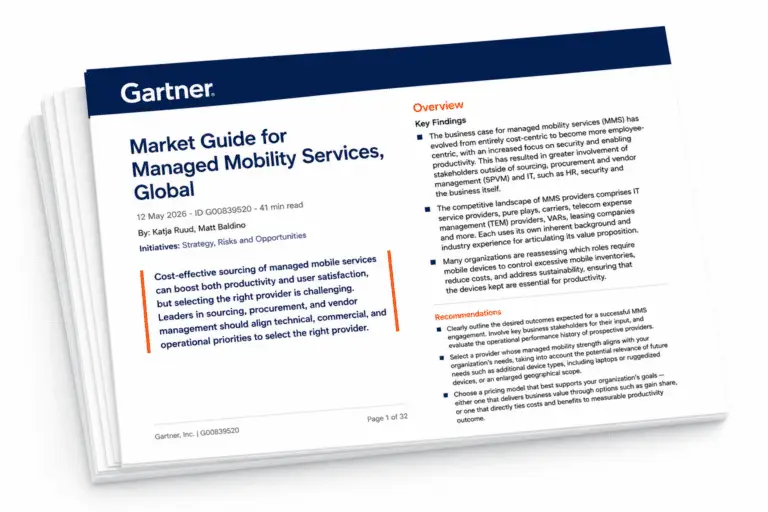
On May 12, 2026, Gartner published its Market Guide for Managed Mobility Services, Global (ID G00839520, by Katja Ruud and Matt Baldino). Brightfin is named as a Representative Vendor.
If you manage a mobile fleet — whether you call it MMS, mobility, EMM, or “the never-ending pile of devices, invoices, and tickets” — this is the Gartner publication you’ll want to read end-to-end. It’s the clearest snapshot of where the managed mobility services market is going, what enterprise buyers are actually asking for, and how to evaluate providers without getting buried in feature lists.
Below are five takeaways that stood out to us. The full guide goes deeper, and you can download the Brightfin-licensed reprint at the end of this post.
Key numbers from the 2026 report
|
1. The MMS business case has flipped from cost-centric to employee-centric
The report’s first key finding is, frankly, the biggest shift in the category: “The business case for managed mobility services (MMS) has evolved from entirely cost-centric to become more employee-centric, with an increased focus on security and enabling productivity.”
Translation: leaders who only talk savings are getting left behind. The new conversation includes HR (because device experience shapes attrition), security (because mobile is the new endpoint), and the business itself (because frontline productivity moves revenue). If your last MMS RFP only graded providers on price, your next one should grade them on user sentiment, XLAs, and digital employee experience.
What this means for IT leaders: build a stakeholder map before you build a vendor shortlist. Sourcing, procurement, IT, HR, security, and the business need to be in the room — and they need to agree on what “successful MMS engagement” actually looks like.
2. AI has crossed from “interesting” to “table stakes”
Gartner identifies AI integration as one of the dominant trends reshaping the MMS market, and it’s no longer just chatbots and ticket deflection. According to the report, the majority of profiled providers use AI for device performance diagnostics and financial management tasks. A growing share use AI-driven real-time language translation for global help desks, AI camera imaging for grading end-of-life devices, and AI orchestration for logistics.
On the financial side specifically, providers are using AI to automate invoice processing, cost categorization, error detection, and tariff optimization. That’s the same problem space Brightfin’s Spend Clearly AI is built to solve at the IT-and-AI-spend layer, and it’s why we believe IT cost optimization is converging with managed mobility faster than most teams realize.
What this means for IT leaders: ask prospective providers for specifics. Where in your workflow does AI actually run? What does it automate? What’s the predicted savings or productivity lift? If a provider can’t answer in concrete terms, the AI is probably still in a slide deck.
3. Sustainability is no longer a “nice-to-have” line item
Gartner’s view: “The MMS market is now mostly aligning with sustainability goals, driven both by regulatory pressures and corporate responsibility but also end-user willingness to support such ambitions.”
The majority of profiled providers offer device recycling and reuse, energy-efficient operations, sustainable procurement support, and ESG reporting. Some are providing carbon calculators that cover both devices and services. If your organization has ESG commitments, your MMS provider needs receipts — carbon metrics, e-waste handling, certified disposal — not just a sustainability page on their website.
What this means for IT leaders: add ESG questions to your RFP. Specifically ask for carbon footprint reporting at the device level, repair-and-reuse rates, and certified disposal documentation.
4. SLAs aren’t enough anymore — XLAs and DEX are how outcomes get measured
This was one of the most striking shifts in the guide. Providers are moving from traditional service-level agreements (SLAs) to experience-level agreements (XLAs) and digital employee experience (DEX) frameworks. Per Gartner, some providers weight XLAs up to ~70% of customer health scores, using AI sentiment analysis, “Pulse Surveys,” and proactive telemetry to measure how the service feels — not just whether tickets closed on time.
Quantitative metrics still matter (call abandonment rates, rapid SLAs for device wipes), but the bigger story is integration: AI-driven sentiment + proactive telemetry + XLAs combine into a much truer picture of end-user experience than any single SLA dashboard can show.
What this means for IT leaders: renegotiate your contracts. Add XLAs alongside SLAs. Define what user-experience excellence looks like, and tie a meaningful portion of provider compensation to it.
5. Pricing is evolving — and the fine print matters more than the headline rate
Gartner notes that the most common MMS pricing model is still a fixed price per device per month, but the structure is shifting. Service desk support, once priced on incident rates and hours, is now usually priced per user. Implementation fees may be bundled or separated — sometimes waived for longer contracts. Some proposals combine fixed device fees with per-event costs (screen replacements, refreshes). Ruggedized environments are increasingly using gain-share models that tie compensation to measurable productivity or cost outcomes.
A few details worth catching before you sign:
- North American MMS deals often include strict autorenewal clauses lasting up to 12 months.
- Global contracts increasingly allow annual price adjustments — sometimes unrelated to inflation.
- Standard payment terms are now typically 30 days, but they’re negotiable.
- Exit/walk-away clauses for chronic SLA or XLA breaches are a safeguard worth fighting for.
- The average MMS contract term sits between 24 and 36 months.
What this means for IT leaders: price isn’t service quality. Build a TCO model that includes per-event costs, refresh cycles, autorenewal exposure, and the cost of an underperforming provider — then negotiate the contract terms, not just the rate card.
Where Brightfin fits in the 2026 picture
Our portfolio spans the full mobile life cycle, leveraging software, managed services, and ServiceNow-native workflows — the same architectural choice that lets enterprise IT, finance, and HR teams work from a single system of record instead of stitching together yet another point tool.
We believe Gartner specifically calls out our focus on regulated industries (financial services, healthcare, manufacturing), our unified handling of BYOD and corporate-liable environments under one governance framework, and our partnership with TRG for comprehensive forward and reverse logistics — repair, storage, and secure end-of-life disposal.
How to actually use this report in your next sourcing cycle
Gartner outlines a 6-step sourcing process. We’d suggest treating it as a literal checklist:
- Define requirements and objectives — and the stakeholders who care about each.
- Assess the competitive landscape, including provider types beyond your incumbent.
- Issue a comprehensive RFP that requests how providers deliver, not just what.
- Evaluate capabilities, pricing, references, and exit clauses.
- Conduct a pilot before you sign at scale.
- Establish governance, roles, responsibilities, and performance metrics — SLAs and XLAs.
If you’re in the middle of an MMS evaluation right now, this is the framework. If you’re not, it’s worth a quarterly check-in against your current provider anyway.