Table of Contents
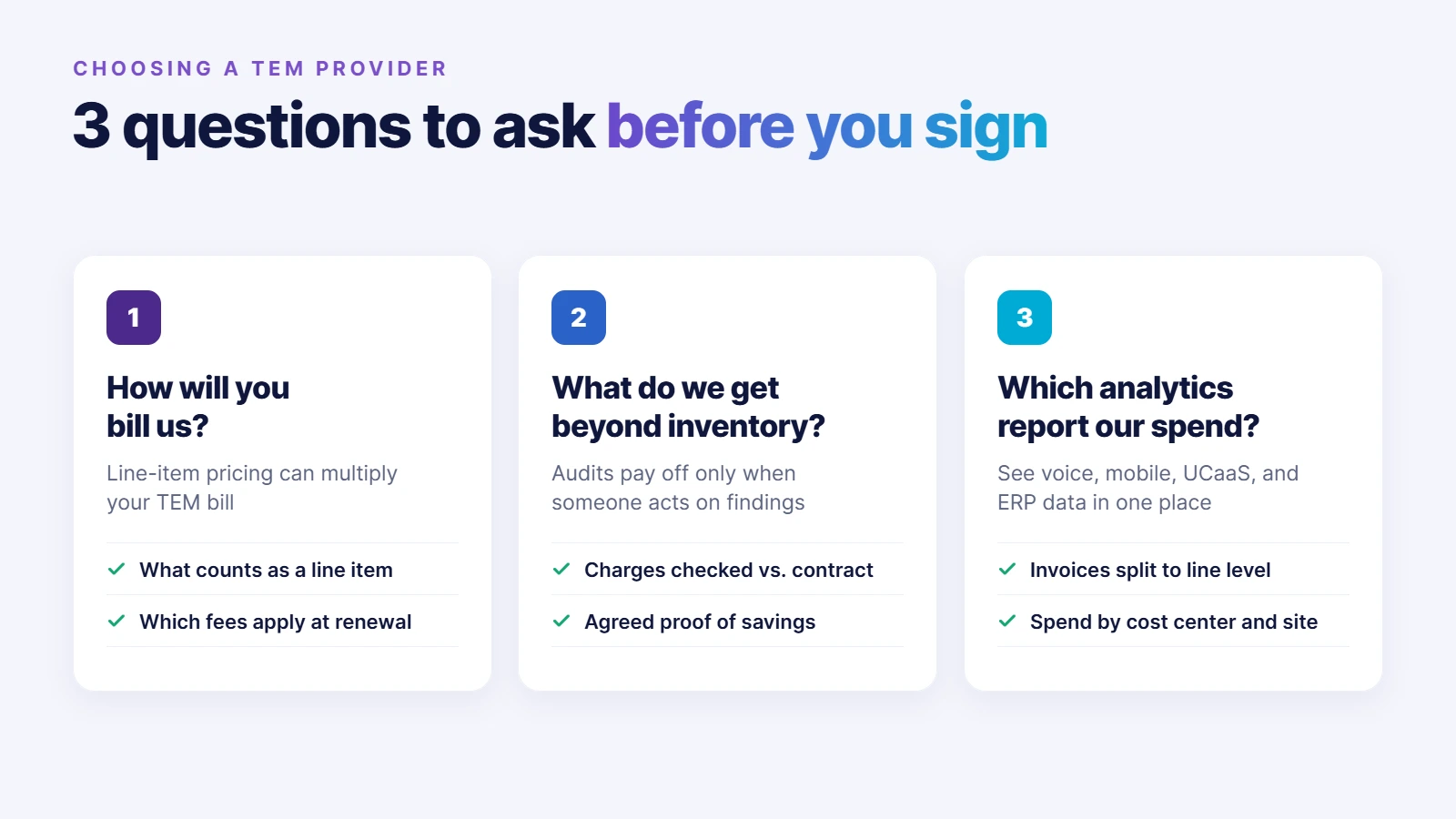
To choose a TEM provider, start with three questions. First, how will the provider bill you? Next, what do you get beyond an inventory? Finally, which analytics tools report your spend? Clear answers expose hidden fees and reporting gaps before you sign.
Updated November 9, 2026.
Why should you choose a TEM provider carefully?
Technology expense management (TEM) tracks, audits, and cuts telecom and technology costs. A good provider turns scattered invoices into one clear view of spend.
First, tech budgets keep growing. Deloitte’s 2023 Global Technology Leadership Study found that the average technology budget reached 5.49% of revenue in 2022.
That figure was 3.28% in 2016, according to the same Deloitte research.
Billing errors add to the pressure. Aberdeen Group research from 2003 found that 7% to 12% of telecom services expenses were in error. A Cisco IT case study reports that figure.
Carrier billing has changed since then, so treat that range as a historical benchmark.
As a result, you need a partner that checks every invoice. These three questions help you find one.
Question 1: How will the provider bill you?
Billing models differ, so your cost can vary widely. Several TEM consultants charge per line item.
For example, picture a dozen MPLS connections (private network links between offices) at a flat $50 each per month. Each link also includes a router, switches, and ports. Suddenly one connection becomes several line items.
As a result, organizations with hundreds of network components can face a much larger TEM bill. Ask for a written pricing example that uses your own invoices.
Ask these questions before you sign:
- What counts as a billable line item?
- Do routers, switches, and ports count separately?
- Which fees apply at renewal?
Question 2: What do you get besides a TEM inventory?
A TEM program usually starts with an audit. The audit inventories your applications, software, devices, licenses, and telecom components.
An inventory is only the starting point. However, the real value comes when the provider uses that data to cut costs and raise return on investment (ROI).
Can the provider check each charge against your contract?
First, ask to see how the provider compares billed charges with contract rates. Vigilis’s August 2026 buyer guide calls line-level invoice data and structured contract terms the questions that separate platforms.
Also ask who acts on each finding. Someone must investigate the error, win approval, and follow up with the carrier, according to Oneview’s October 2026 buyer guide.
How will the provider measure savings?
Next, agree on the measures up front. Oneview’s guide separates four outcomes, and each needs its own proof.
| Outcome | Proof to request |
|---|---|
| Potential saving | Validated opportunity |
| Recurring reduction | Lower charge on later invoices |
| One-off recovery | Credit or refund received |
| Cost avoidance | Documented estimate, reported separately |
Question 3: Which analytics tools show and report your spend?
After the provider builds the inventory, analytics tools give you deeper insight into spending. Look for tools that combine voice, mobile, and UCaaS (cloud calling and collaboration) expenses.
Connecting your ERP (enterprise resource planning) data adds more context. As a result, your team sees the full cost of technology in one place.
Strong tools also let leaders drill into telecom, cloud, and data costs. Then they can rank current spending and plan future investments.
Ask the provider to show you:
- A real invoice expanded to individual lines
- Spend split by cost center, site, and user
- Reports that combine voice, mobile, UCaaS, and ERP data
What do buyers ask most about choosing a TEM provider?
What is technology expense management?
TEM tracks, audits, and optimizes telecom and technology spending. As a result, you pay only for what you use.
How do TEM providers charge?
Pricing models vary, so many consultants charge per line item, so ask for a pricing example before you sign.
What should a TEM audit include?
An audit should inventory your applications, software, devices, licenses, and telecom components. Then it should use that data to find savings.
Do you need analytics with a TEM service?
Yes. Analytics combine voice, mobile, UCaaS, and ERP data, so your team can see and rank every cost.
What is your bottom line?
Technology connects nearly every business function. The right TEM services partner helps you control telecom spending today and get more from your assets over time.
Do you have questions about managing telecom spending and mobile assets? Get in touch with our team.
Related reading
- Technology Expense Management: What Is It?
- 5 Key Strategies for TEM
- How TEM Outsourcing Can Help You