Table of Contents
Your new hire starts Monday and the laptop shipped last week, but the phone is stuck in a carrier portal waiting on a manual order nobody submitted.
That gap between “device ordered” and “device in hand” is where mobility programs tend to come apart. Ordering, provisioning and tracking often run in separate systems that no single team owns, so every handoff is a chance for a wrong plan, a wrong address or an asset record that stops matching reality.
This guide compares five platforms that handle device provisioning for large mobile fleets. It sorts them into the three kinds of tool they are, shows where each one fits, and ends with questions to ask every vendor before you sign.
Quick guide: five platforms, three types
The right pick depends on what you already run and who owns the program. Platforms are listed alphabetically.
- Brightfin Mobility Management (managed mobility on ServiceNow): best for ServiceNow organizations that want ordering, staging, asset tracking, invoice auditing and support in one workflow.
- Calero (expense management): best for organizations with a large unified communications estate next to their mobile fleet.
- Sakon (expense management with ServiceNow catalog items): best for ServiceNow teams that want ready-made catalog items for common requests and normalized invoice data across many carriers.
- ServiceNow ITAM (platform module): best for teams with ServiceNow developers who want to build their own provisioning workflows.
- Tangoe (expense management): best for teams that need mobile, fixed telecom and cloud spend in one reporting view, whatever ITSM platform they use.
What provisioning software has to do
A provisioning workflow runs from request to retirement, and every stage is a place where data can fall out of sync.
- Request and approval: an employee or manager asks for a device and the right approver signs off.
- Carrier order: the device, plan and shipping address go to the carrier.
- Staging and kitting: the device gets security profiles and apps loaded, then ships.
- Activation and enrollment: the line goes live and the device enrolls in your unified endpoint management (UEM) tool.
- Active use: usage and invoice lines attach to a device, a user and a cost center.
- Return and retirement: the device is wiped, recycled or traded in, and the line is closed.
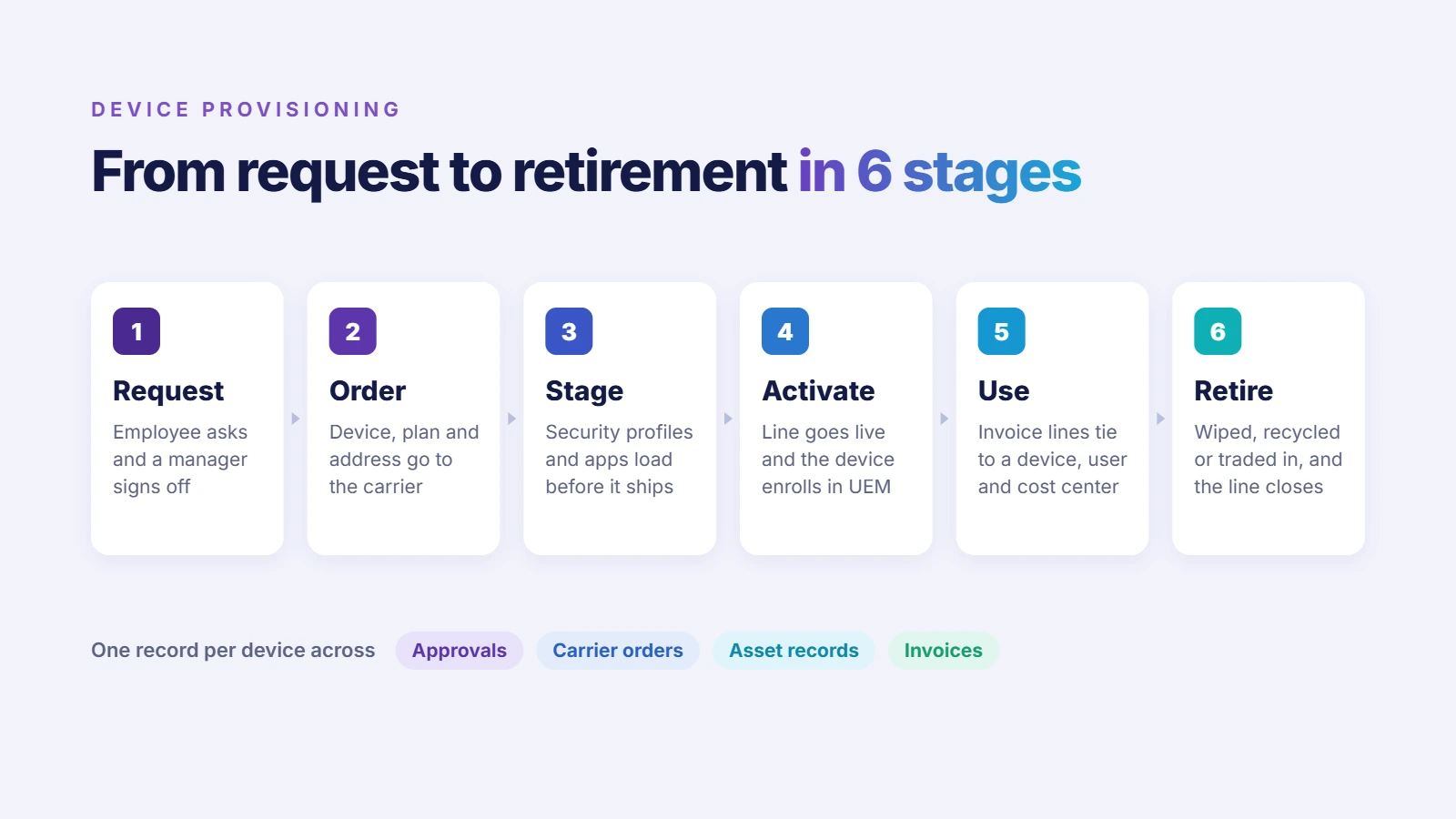
We evaluated each platform on six criteria that map to those stages. Fast provisioning loses its value if asset records drift out of sync within weeks, so several criteria cover what happens after delivery.
- Automated ordering and fulfillment: can you place an order, route approvals and trigger carrier fulfillment in one workflow?
- Lifecycle tracking: does the asset record stay current through activations, swaps, repairs and decommissioning, so you stop paying for devices no longer in service?
- Carrier integration: does the platform use eBonding, a direct API connection to the carrier’s ordering system, or does someone re-key orders in a portal?
- Expense visibility tied to assets: can you map every invoice line to a device, a user and a cost center?
- ServiceNow integration: does provisioning data live where your IT service management (ITSM) and IT asset management (ITAM) teams already work?
- Managed services depth: does the vendor handle disputes, plan optimization and end-user support?
Weight the criteria for your environment. A team already on ServiceNow may put criterion 5 first, and a team with mixed telecom and cloud bills may start with criterion 4.
Three kinds of tool on one shortlist
The five platforms solve different problems, so sort them before you compare features. A telecom expense tool and an asset module can both appear on a shortlist while answering different questions.
| Type | What it does | Platforms here | Usually owned by |
|---|---|---|---|
| Technology expense management (TEM) | Ingests carrier invoices, allocates cost and tracks disputes. Ordering and provisioning features vary by vendor. | Calero, Sakon, Tangoe | Finance and telecom teams |
| ITAM platform module | Tracks hardware in the configuration management database (CMDB) and automates the workflows you build. Carrier integration and invoice work need custom development or a partner app. | ServiceNow ITAM | IT asset management and ServiceNow developers |
| Managed mobility on ServiceNow | Combines ordering, staging, tracking, invoice auditing and support as software plus services on the ServiceNow data model. | Brightfin Mobility Management | IT operations and finance together |
The types can be combined. Brightfin Mobility Management is itself built on the ServiceNow platform, so it extends ServiceNow ITAM and doesn’t replace it.
The five platforms, side by side
Each platform gets the same four lines, in alphabetical order.
Brightfin Mobility Management
- Best for: organizations already on ServiceNow that want ordering, staging, asset tracking and invoice auditing in one workflow.
- How it provisions: orders go to the carrier through eBonding, devices are staged and kitted with security policies and apps, approvals run through ServiceNow workflows, and the asset record updates in the CMDB. [INSERT BRIGHTFIN RESULT: typical order-to-delivery time with eBonding versus a manual portal order]
- Strengths: the data model is native to ServiceNow, so there’s no sync between systems. Managed services cover staging, kitting, UEM administration, a 24×7 help desk and reverse logistics. Siemens manages more than 160,000 mobile devices and uses Brightfin Sync and Brightfin Order to keep one record per device in ServiceNow. [INSERT SOURCE LINK] Gartner lists Brightfin as a Representative Vendor in its 2026 Market Guide for Managed Mobility Services, a market listing that doesn’t rank vendors. [INSERT SOURCE LINK]
- Considerations: it’s built for ServiceNow, so organizations not yet on the platform need to factor that decision into their timeline. Migration maps legacy asset records to ServiceNow tables before go-live, which takes planning. Cost allocation models are configured to match your financial structure.
Calero
- Best for: organizations with a large unified communications (UC) estate next to their mobile fleet.
- How it provisions: employees order devices, request upgrades and change plans in a self-service portal with role-based catalogs. International staging and deployment run through partner TRG Solutions.
- Strengths: UC, mobile and telecom costs sit in one reporting system. Inventory, contracts and service lines appear in one view, and contract tracking helps procurement monitor carrier agreements.
- Considerations: Calero runs outside ServiceNow, so CMDB and ITSM integration takes implementation work. Staging and kitting depend on a partner. Broad UC coverage adds configuration work for teams that only manage a mobile fleet.
Sakon
- Best for: ServiceNow teams that want ready-made catalog items for common mobility requests and normalized invoice data across many carriers.
- How it provisions: SakonMobile includes out-of-the-box ServiceNow catalog items for device orders, SIM replacements, service suspensions, plan changes and employee onboarding and offboarding.
- Strengths: a data normalization engine maps invoice lines from many carriers to one taxonomy, which reduces mapping errors. Sakon reports global carrier management across more than 100 countries and 150 carriers, and its published case studies say ServiceNow uses Sakon internally.
- Considerations: the core expense platform runs outside ServiceNow, so data needs to sync between systems. Staging, kitting and physical fulfillment are add-on services. Invoice auditing and cost optimization depth varies by service tier.
ServiceNow ITAM
- Best for: teams with ServiceNow developers who want to design their own provisioning workflows.
- How it provisions: Flow Designer and App Engine let your team build device ordering and approval workflows, and hardware assets are tracked from procurement to retirement as native CMDB records.
- Strengths: there’s no external system to manage, CMDB records are shared across ITSM, IT operations management and ITAM, and workflows can match your exact process.
- Considerations: carrier eBonding, invoice auditing and expense optimization aren’t included out of the box. Mobility workflows need internal ServiceNow development, and the base module has no managed services, help desk or reverse logistics. A partner application built on the platform can fill those gaps.
Tangoe
- Best for: companies that need mobile, fixed telecom and cloud costs in one reporting view, whatever ITSM platform they use.
- How it provisions: ordering and provisioning run in Tangoe’s own portal.
- Strengths: the platform ingests and normalizes invoices from hundreds of carriers, flags billing errors through dispute workflows and tracks them to resolution with carriers. Dashboards break spend down by department, location and carrier, and Tangoe reports managing more than 14 million devices.
- Considerations: Tangoe runs outside ServiceNow, so device and expense data live in a separate system from your ITSM workflows. Connecting it to the ServiceNow CMDB takes additional integration work.
Comparison table
Two platforms run natively in ServiceNow, and the other three connect to it or sit outside it. Cells that say “Confirm with vendor” are ones we couldn’t verify when we wrote this guide. Pricing varies by fleet size and scope, so it’s covered in the practical details below.
| Platform | Runs in ServiceNow | Carrier eBonding | Staging and kitting | Invoice auditing | Managed services | Global coverage |
|---|---|---|---|---|---|---|
| Brightfin Mobility Management | Yes, built on ServiceNow | Yes | Yes | Yes, automated against contracts | Yes: staging, UEM administration, help desk, reverse logistics | Multi-carrier, multi-country |
| Calero | No, separate platform | Confirm with vendor | Via partner (TRG Solutions) | Confirm with vendor | Confirm with vendor | International staging through TRG Solutions |
| Sakon | Catalog items connect; core platform runs outside | Confirm with vendor | Add-on service | Varies by service tier | Global carrier management services | 100+ countries, 150 carriers (company-reported) |
| ServiceNow ITAM | Yes, native | Not included out of the box | Not included | Not included | Not included | Not applicable |
| Tangoe | No, separate platform | Confirm with vendor | Confirm with vendor | Dispute workflows flag billing errors | Confirm with vendor | Hundreds of carriers; reports 14M+ devices |
How to choose
Find the row that matches your environment, then test that platform against the questions in the next section.
| Your situation | Start with | Why |
|---|---|---|
| You run ServiceNow and want ordering, staging, tracking, invoices and support from one vendor | Brightfin Mobility Management | One data model and managed services included |
| You run ServiceNow, have developers available and a provisioning process that doesn’t fit a packaged workflow | ServiceNow ITAM | Full control over workflows, with eBonding and invoice auditing to build or add through a partner |
| You run ServiceNow and mainly want ready-made catalog items plus normalized invoices | Sakon | Out-of-the-box catalog items; confirm which staging and fulfillment add-ons you’d need |
| Your bills span mobile, fixed telecom and cloud, and finance leads the program | Tangoe | Multi-domain reporting; budget for ServiceNow integration if your ITSM runs there |
| You manage a large UC estate alongside mobile | Calero | UC, mobile and telecom costs in one report |
| You aren’t on ServiceNow and have no plans to move | Tangoe, Sakon or Calero | Brightfin is built for ServiceNow environments and wouldn’t fit |
If two rows describe you, the deciding factor is often who owns the program day to day. Finance-led programs tend to lean toward expense platforms, and IT-led programs tend to lean toward ServiceNow-based options.
Practical details: timeline, pricing, migration
Implementation timeline
Go-live time depends on the number of carriers and countries, the state of your ServiceNow instance, your UEM tool and the quality of your legacy asset data. Ask each vendor how long a customer with a similar fleet took to go live, and get the answer in writing. [INSERT BRIGHTFIN TYPICAL IMPLEMENTATION TIMELINE BY FLEET SIZE]
Pricing models
Vendors commonly price by a per-device monthly fee, a percentage of managed spend, or a platform license plus separate fees for services such as staging, help desk and reverse logistics. Ask which services sit outside the base price, since staging, kitting and dispute handling can be priced separately. A custom build on ServiceNow ITAM adds internal development time to the license cost. [INSERT BRIGHTFIN PRICING MODEL]
Migration
Clean data goes in first, whichever platform you pick.
- Export your current asset inventory and carrier line lists.
- Reconcile them against recent invoices to find lines with no device and devices with no line.
- Map the fields to the ServiceNow tables or the vendor’s data model.
- Define the cost center structure the platform should allocate to.
- Agree a cutover date and name who owns exceptions after go-live.
Questions to ask every vendor
- Which carriers connect through eBonding today, and which orders still need manual entry?
- Where does the asset record live, and how soon after a carrier activates a line does it update?
- Who stages and kits devices, and in which countries?
- How are invoices audited against contracts, and who files and follows up disputes?
- What does the CMDB integration look like, and who maintains it?
- What will my team need to provide before go-live?
- How is pricing structured, and which services sit outside the base price?
- What happens to a device record when the device is returned, wiped and recycled?
Frequently asked questions
What is automated device provisioning?
Automated device provisioning connects the device order to carrier fulfillment, configuration and delivery in one workflow. Approvals, carrier orders, staging and asset records move forward without anyone re-keying data between systems, so a new hire gets a configured device on day one.
How does mobility management differ from mobile device management?
Mobile device management (MDM) handles device security, configuration and policy enforcement. Mobility management is broader and covers procurement, expenses, lifecycle tracking and operational workflows. The two usually run side by side: an MDM or UEM tool secures the device, and a mobility platform handles ordering, billing and lifecycle records.
Does a mobility platform need to run natively inside ServiceNow?
It depends on where your IT teams work. A native platform keeps asset, expense and workflow data in the same tables as your ITSM and CMDB records, which avoids sync delays. A platform outside ServiceNow can still work if you budget for integration and accept that device data lives in two systems.
How does carrier eBonding speed up provisioning?
eBonding is a direct API connection between your platform and the carrier’s ordering system. An order goes from the request to the carrier’s fulfillment queue without a portal login, which removes re-keying errors such as wrong devices, plans or shipping addresses. Asset records can then update when the carrier processes the order.
What inventory data should a mobility platform track at each lifecycle stage?
At procurement, track the device model, carrier, plan, cost center and approval chain. After deployment, add UEM enrollment status, compliance, assigned user and location. During use, tie usage and invoice lines to each device. At end of life, record return status, data wipe confirmation, trade-in value and disposal method.
How does mobility software reduce fleet costs?
It audits invoices against contracts, flags billing errors, right-sizes plans from usage data and identifies unused devices and lines. Connecting expense data to asset records shows where each dollar goes, so you can cut waste at the line-item level.
Can mobility software handle international device deployments?
Yes, when the platform has carrier integrations in the countries you operate in. Check how many carriers connect through eBonding, where devices are staged and which countries the help desk covers. Centralized expense reporting then gives you one view of global spend.
See a provisioning workflow run end to end
If you run ServiceNow and your provisioning workflow still has manual handoffs, watch Brightfin run one from order to retirement. [INSERT LINK: book a provisioning workflow walkthrough]
Sources: Siemens customer story, Brightfin Sync and Brightfin Order [INSERT SOURCE LINK]. Gartner, Market Guide for Managed Mobility Services, 2026 [INSERT SOURCE LINK]. Vendor product information from Calero, Sakon, ServiceNow and Tangoe [INSERT SOURCE LINKS].