
Table of Contents

Most telecom teams already run requests through ServiceNow, but a lot of the real work still happens somewhere else. Circuit changes go out by email, carrier orders happen in portals, and contract approvals live in spreadsheets. Brightfin Release 26.20 brings that work back into the platform, so telecom expense management for ServiceNow now covers the order, the contract, and the bill in one place.
That matters for a simple reason. When the order and the invoice share a record, the audit knows what you actually asked for. As a result, billing errors have far fewer places to hide. Here is what is new in 26.20, and why it adds up to more than a list of features.
Release 26.20 at a glance
Here is what Release 26.20 adds to telecom expense management for ServiceNow:
- A new carrier API: T-Mobile USA joins AT&T and Verizon in Brightfin carrier automation.
- Fixed changes in the platform: Plan, feature, and one-off circuit requests now run in ServiceNow.
- Contracts with a workflow: Agreements now move through approvals, renewals, and commitment tracking in the portal.
- Invoices on time: Automated invoice delivery and faster processing keep your data current.
- Savings you can show: A redesigned Savings Dashboard breaks out annualized savings by provider, type, and country.
Why telecom expense management for ServiceNow needs the whole lifecycle
A TEM tool that sits beside ServiceNow sees the invoice. However, it often cannot see the request behind the charge. So when a carrier bills for a feature, nobody can quickly confirm that someone ordered it.
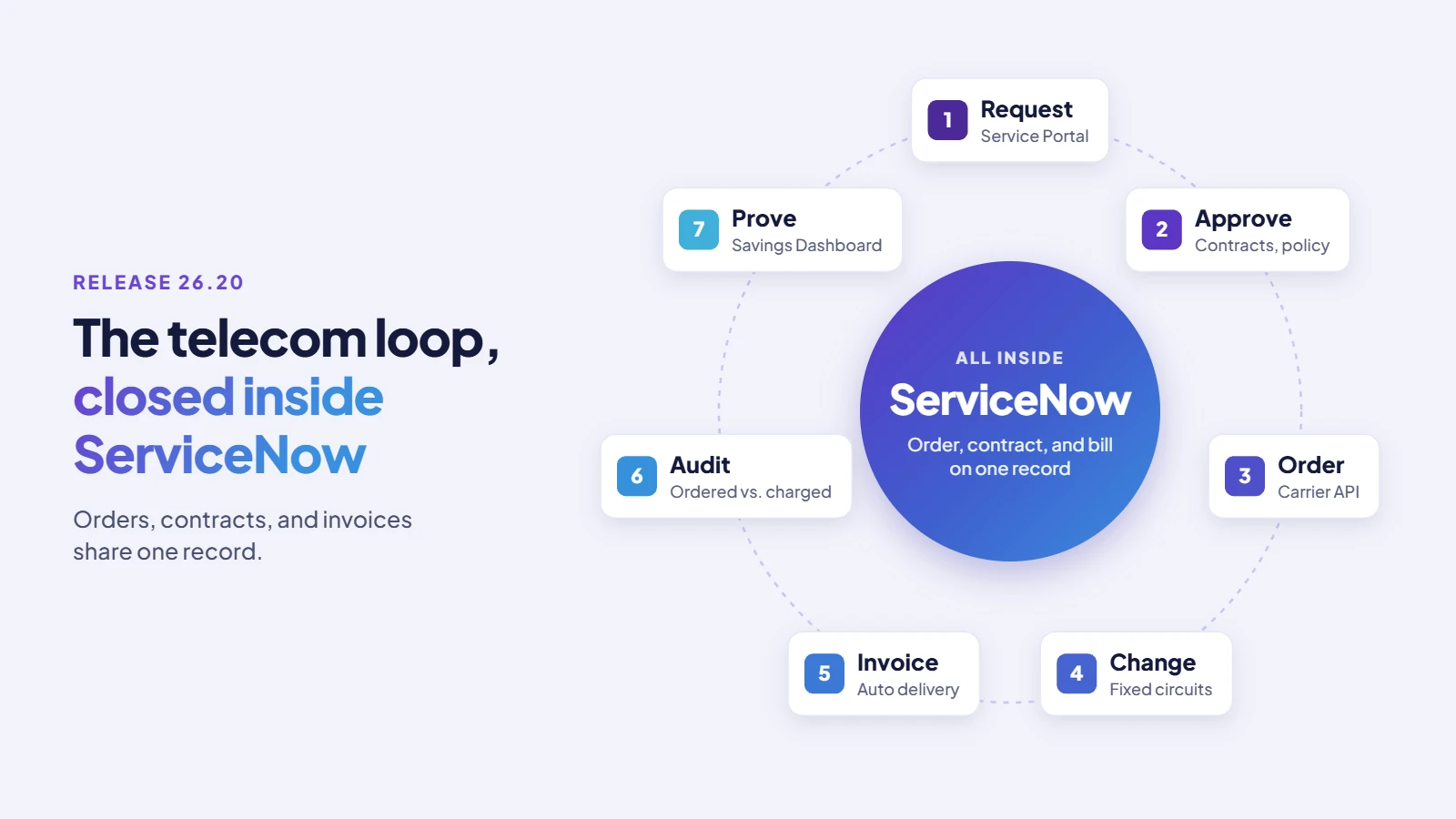
Brightfin works differently, because it is built natively on ServiceNow. Your telecom requests, approvals, inventory, and invoices all share the same platform and the same data. Release 26.20 extends that advantage to the places where work used to slip away: mobile carrier orders, fixed circuit changes, contract approvals, and invoice delivery.
In short, the more of the lifecycle that runs in ServiceNow, the more your audit can prove. That is the real promise of telecom expense management for ServiceNow, and this release moves it a long way forward.
Mobile: from ServiceNow request to carrier, without the inbox
Release 26.20 adds T-Mobile USA to Brightfin carrier API automation. Your team can now order a new device and number, disconnect a line, reassign a number, and suspend or restore service straight from a ServiceNow request. For example, when an employee leaves, you can cancel or reassign the line right away, instead of paying for it until someone logs in to a carrier portal.
In addition, the release builds company policy into the request itself:
- ETF waivers for Verizon upgrades. Set waiver conditions as contract terms, apply them through the carrier API, and see how many waivers remain in the Service Portal.
- More orders through the API. Fulfillment teams can now pick the right pricing option, such as installment, retail, or a 2- or 3-year contract, for AT&T, Verizon, and T-Mobile USA. So fewer orders fall back to manual work.
- The right SIM for each device. SIM type now follows the device model, with eSIM selected first when a device supports both. Admins also decide whether new SIMs arrive active or inactive.
- Global stockrooms. Multiple virtual stockrooms with full data separation let you run fulfillment for every region from one environment.
With telecom expense management for ServiceNow, policy applies when someone makes a request, not after the bill arrives.
Fixed services and contracts: nothing changes off the record
Until now, fixed services had a gap. Plan changes and one-off circuit requests often happened over email or in spreadsheets. As a result, the audit trail broke, and billing checks had nothing to compare against.
Release 26.20 closes that gap with two new request types:
- Change plan or feature. Add, remove, or change agreement-based plans and features on a fixed circuit, with full context of what is already in place.
- Request additional support. Raise circuit-level actions that do not fit a standard change, such as a new billing account number. You can also configure the action types to match your own processes.
This is where telecom expense management for ServiceNow pays off. Because every change now lives in the platform, billing audit can compare what you ordered with what the carrier charged. Both request types also feed the quote and rate change management that arrived in Release 26.10.
Contracts get the same treatment. Users can now submit, approve, adjust, renew, and cancel agreements in the Technology Portal, and the portal tracks every approval from request to decision. Meanwhile, new agreement-level commitment tracking flags shortfalls and expiring agreements before they turn into problems.
Invoices and savings: on time, and easy to prove
An audit only works if the invoices arrive. That is why Brightfin now automates invoice delivery from carrier portals. It works around the clock, checks portals again, and picks up each invoice when it lands. So your data stays complete, and nobody has to upload files by hand.
Once invoices arrive, processing moves faster too:
- Smoother imports. Total mismatches and allocation edge cases no longer stop processing.
- Clearer variances. Brightfin now matches missing previous invoices, so variance reviews make more sense.
- Accurate account data. Bulk updates save time, and missing-invoice tracking now skips inactive accounts. Cost history also lines up with invoice months.
Finally, the redesigned Savings Dashboard shows proposed and realized savings the way you want to see them. You can configure it, filter by provider, type, and country, and view annualized savings in every widget. Likewise, new Home page analytics show cost by country and take you from summary to detail in fewer clicks.
Brightfin customers see a 20 to 30 percent average reduction in telecom costs. Now that number is easier to show, because telecom expense management for ServiceNow keeps the proof in the same place as the spend.
Certified for the ServiceNow releases you run
Release 26.20 carries ServiceNow certification for the Yokohama, Zurich, Australia, and Brazil releases. So your telecom expense management for ServiceNow can keep pace with your platform upgrades.
It also reflects a steady pace of investment. Brightfin shipped 52 enhancements in 26.20 and 110 so far in 2026. Every one of them runs inside the instance you already secure and govern, with no second platform to maintain.
FAQs about telecom expense management for ServiceNow
Is Brightfin telecom expense management for ServiceNow a native app?
Yes. Brightfin runs as scoped, certified applications built natively on ServiceNow, and it holds the Built on Now designation. You can find it in the ServiceNow Store. Your telecom data, workflows, and approvals stay inside your own instance.
Which carriers gained API automation in 26.20?
Release 26.20 adds T-Mobile USA, with support for new orders, disconnects, number reassignment, and suspend and restore. In addition, AT&T and Verizon orders gain new pricing options, and Verizon upgrades now support ETF waiver policies.
Does telecom expense management for ServiceNow cover fixed and mobile services?
Yes. Release 26.20 updates fixed services, such as circuits and plans, as well as mobile devices, lines, and SIMs. Both run on the same Brightfin foundation inside ServiceNow, so invoices, contracts, and analytics work the same way across them.
See every telecom change on the record in a 30-minute demo.
Watch a request go from ServiceNow to the carrier, then see the bill checked against it. We will walk you through Release 26.20 and show where it fits your telecom program.