
Table of Contents
IT Chargeback for AI Spend: How Finance and IT Leaders Control AI Costs
AI is now the fastest-growing line item in the IT budget — and one of the hardest to govern. IT chargeback and showback give finance and IT leaders the visibility to control AI costs today. Worldwide AI spending is forecast to reach $2.59 trillion in 2026, a 47% jump in a single year, according to Gartner. Here is how showback and chargeback bring that spend under control inside ServiceNow — and where Brightfin ITFM is headed next.
Why AI costs are so hard to control
AI has become the fastest-growing item in the enterprise technology budget. Gartner forecasts worldwide AI spending will reach $2.59 trillion in 2026, with AI infrastructure alone accounting for more than 45% of that total and generative AI model spending climbing roughly 80% year over year.
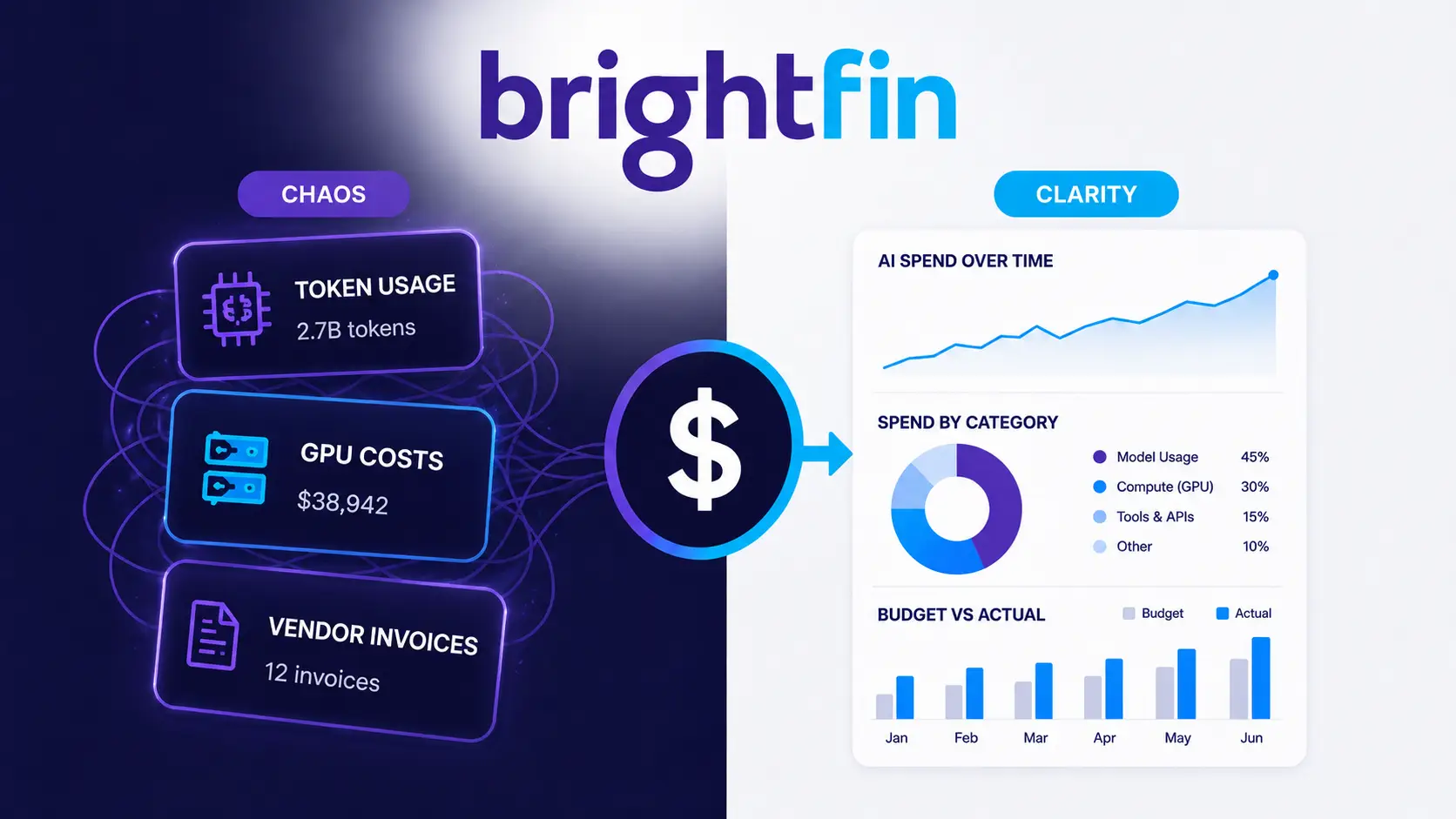
For CIOs and CFOs, the question is no longer whether to invest in AI. It is whether they can see and control what they are already spending. Three traits make AI spend uniquely difficult to govern:
- It is consumption-based and volatile. Costs accrue by tokens processed and GPU hours consumed, so one successful pilot can multiply a department’s bill almost overnight.
- It is decentralized. Marketing, engineering, support, and finance each buy AI independently, creating “shadow AI” that never appears in a central forecast.
- It is hard to attribute. Shared model endpoints serve dozens of teams at once, so no single owner is obvious.
The result is an accountability gap. Finance leaders face mounting pressure to answer the question every board is now asking — what is our return on AI spend? — without the visibility to do it.
What is IT chargeback for AI spend?
IT chargeback for AI spend is the practice of allocating the cost of AI services — model and API usage, AI-optimized infrastructure, copilots, and cloud consumption — back to the business units, teams, or projects that consume them. Each dollar is tied to the team that spent it, and that cost moves into the team’s own budget.
This is where IT financial management (ITFM) earns its keep. Chargeback turns a single, opaque AI invoice into a clear bill of accountability for every consuming team.
| Meet Brightfin at ITFMA 2026
The IT Financial Management Association’s Financial World of Information Technology conference runs July 20–24, 2026 at the Rosen Plaza in Orlando, FL. brightfin will be there to show how ITFM on ServiceNow turns AI spend into a strategic advantage. |
Showback vs. chargeback: what is the difference?
Showback reports what each team consumed and what it cost without transferring money. Chargeback bills that cost back to the consuming team’s budget. Showback builds awareness; chargeback drives accountability. Both rest on the same foundation: clean, automated cost allocation.
Most organizations should start with showback to build trust in the data, then move to chargeback once allocation is accurate and accepted.
How showback and chargeback work in modern ITFM
The encouraging news is that the core discipline already works today. Brightfin ITFM, built 100% natively on ServiceNow, lets IT and finance leaders bring AI and cloud spend into the same framework they use for the rest of the technology budget. It rests on three capabilities:
- Cost transparency. Automate data management, expense-driver alignment, and cost allocation across services and business units — including cloud workloads imported directly from AWS, Microsoft Azure, and Google Cloud.
- Billing simplicity. Generate system-driven invoices that communicate costs, differentiate service cost drivers, and provide digestible traceability — turning showback and chargeback into a repeatable process.
- Budget clarity. Run budgets, forecasts, and variance analysis through automated workflows so spend shows up in your numbers in real time, not at quarter close.
The four steps of AI chargeback
A lean IT finance team can run AI chargeback in four steps:
- Capture every source. Bring AI and cloud invoices, model APIs, AI-optimized infrastructure, and SaaS copilots into one system of record automatically.
- Define an allocation model. Split shared resources, such as a common model endpoint or GPU cluster, using AI-native usage metrics rather than rough estimates.
- Map costs to consumers. Tie every dollar to a department, cost center, or project so ownership is unambiguous.
- Report, then bill. Start with transparent showback and graduate to automated chargeback as confidence grows.
Where AI cost optimization is headed next
Today’s tooling handles cloud and AI invoices well. But AI introduces cost dynamics that traditional allocation models were never designed for: usage measured in tokens and GPU-seconds, shared model endpoints serving dozens of teams, and bills that can swing by orders of magnitude from one week to the next. That is why Brightfin is building toward AI-native IT cost optimization, with a simple mission: help CIOs see clearly and spend better.
Seeing clearly starts with unifying your AI and IT estate in one place — breaking spend down by vendor, product, and model, tracking what is sanctioned versus what is actually running, and surfacing the behavioral signals that show where costs come from and why. That visibility is exactly what real chargeback depends on: you cannot allocate what you cannot see.
Spending better starts with AI usage itself. Token management is the lever most enterprises do not know they have. By breaking token spend down by model, team, and input versus output — and flagging the waste hiding in plain sight, from runaway prompts to oversized context windows and silent retries — organizations can fund their AI strategy out of the savings instead of asking the CFO for more budget.
On that foundation, AI assistants make the work effortless:
- A plain-language budget Q&A answers spend questions in seconds.
- An invoice assistant flags exceptions and billing errors automatically.
- A contract assistant surfaces renewal risks and cost exposure.
The vision is an ITFM platform where AI spend is as measurable, allocable, and accountable as any other service — all inside ServiceNow. We would love to compare notes with the IT finance community on what that future should look like.
Frequently asked questions
What is the difference between AI showback and chargeback?
Showback reports what each team consumed and what it cost without transferring money. Chargeback bills that cost back to the consuming team’s budget. Showback builds awareness, while chargeback drives accountability.
How do you allocate shared AI costs?
Shared resources like a common model endpoint or GPU cluster are split using an allocation model based on usage metrics — tokens, API calls, or compute hours — or an agreed percentage. A capable ITFM platform automates the split.
Will chargeback slow down AI adoption?
Done well, no. The goal is not to discourage AI use but to make its cost visible so teams invest where the return is highest. Transparency tends to accelerate adoption of the highest-value use cases.
How does Brightfin handle AI and cloud costs?
Brightfin ITFM imports cloud and AI invoices from AWS, Azure, and Google Cloud into ServiceNow, allocates them to the right consumers, and generates the invoices that power showback and chargeback.
How much is enterprise AI spending growing?
Gartner forecasts worldwide AI spending will reach $2.59 trillion in 2026, a 47% increase year over year, with AI infrastructure accounting for more than 45% of the total. This makes accurate AI cost allocation through showback and chargeback a priority for IT finance leaders.