
Table of Contents
IT budgets get approved once a year. IT spend does not stand still for any of it.
Cloud usage shifts weekly. Telecom and mobile contracts renew on their own timelines. Software licenses get added by teams that never call IT first. By the time a CIO sees a report that ties all of it together, the quarter that produced those numbers has usually already closed. IT spend management is the discipline, and increasingly the software, built to close that gap: tracking, allocating, and forecasting technology costs so IT and finance are looking at the same numbers on the same day, instead of reconciling two different stories a month later.
The visibility problem is getting worse, not better. Flexera’s 2026 State of ITAM Report found that complete IT asset visibility has dropped to 36% across the organizations it surveyed, and only 31% report accurate visibility into their AI software spend even as adoption accelerates. Nearly half were audited by a software vendor in the past year. For a CIO trying to defend a budget in front of the CFO, those are not abstract industry numbers. They describe exactly the conversation that goes badly when nobody in the room trusts the spreadsheet.
This guide compares the platforms enterprise CIOs and IT finance leaders evaluate most often for real-time IT spend visibility, what each one is actually built to do, and where Brightfin fits into that picture.
What real-time IT spend visibility actually requires
Real-time IT spend visibility means the cost data reflects what is happening now, not what happened last billing cycle, and it means that data is trustworthy enough to act on without a reconciliation project first.
That requires three things most organizations lack today: a single data model that spans cloud, telecom, mobile, and software rather than four separate systems each finance has to stitch together by hand; cost data drawn from actual invoices and usage records instead of estimates modeled off general ledger codes; and a live connection to the systems where IT actually manages services and assets, so cost and operations stop living in different tools.
Most IT cost management tools solve one piece of that. Very few solve all three.
What to look for in an IT spend management platform
Before comparing specific products, it helps to know which criteria actually separate a platform that changes how a CIO runs the budget from one that just adds another dashboard to check.
- Breadth of spend covered. A tool that tracks telecom and mobile well but treats cloud and software as an afterthought will leave the largest and fastest-growing part of the budget under-managed.
- Data source, not just data display. Dashboards built on general ledger estimates tell you what finance assumed you spent. Dashboards built on carrier invoices, vendor bills, and usage records tell you what you actually spent, down to the line item.
- Native connection to your service management system. If IT spend management lives outside the platform where assets, contracts, and services are already tracked, someone is maintaining an integration or reconciling two systems by hand. For the large share of enterprises running ServiceNow as their system of record, that matters directly.
- Time to value. A platform that takes 12 to 18 months to configure delays the exact financial discipline it was bought to create.
- AI that answers a specific question, not a slogan. Ask what the AI actually does: what data it reads, what question it answers, and what a person still has to approve before money moves or a chargeback goes out.
The best IT spend visibility tools for CIOs in 2026
1. Brightfin, best for unified TEM and ITFM built natively on ServiceNow
Brightfin combines technology expense management and IT financial management inside a single data model built natively within ServiceNow, covering mobile, telecom, cloud, and software spend together rather than as separate tools bolted side by side. Because the platform runs on real invoices and usage data rather than modeled estimates, cost allocations hold up when finance and the business units being charged ask where a number came from.
Brightfin reports customers see 20 to 40% improvements in cost visibility and financial planning cycles that run 30% faster once budgeting, cost modeling, and cost recovery are automated directly on ServiceNow. On the implementation side, Brightfin’s comparison of legacy ITFM platforms cites transition efforts and implementation time cut by up to 80%, with organizations operationalizing ITFM on ServiceNow in under 90 days rather than the multi-year rollouts common with standalone systems. Brightfin also reports a 99% customer retention rate, which is a meaningful signal in a category where switching platforms every few years has historically been the norm.
Best for: enterprises running ServiceNow that want telecom, mobile, cloud, and software spend, plus the financial layer that allocates and forecasts it, in one native platform instead of stitched-together point tools.
2. IBM Apptio, best for enterprises standardizing on TBM cost taxonomy
IBM Apptio unifies financial and operational data using an industry-standard cost taxonomy, with modules like ApptioOne for IT cost transparency and Cloudability for cloud cost optimization. It is a mature, well-established platform, particularly for enterprises already standardized on IBM infrastructure or the broader technology business management framework. It runs as a standalone platform that connects to ServiceNow rather than operating natively inside it, and enterprise deployments typically involve a longer configuration and change management cycle than a platform built inside the ITSM tool IT already uses daily.
Best for: large enterprises with a dedicated TBM practice and the internal resources to run a standalone cost-modeling platform alongside ServiceNow.
3. Nicus, best for ServiceNow-native ITFM cost modeling
Nicus is one of the few other platforms built natively inside ServiceNow, focused on ITFM budgeting, forecasting, chargeback, and cost transparency. It is a direct comparison point for ServiceNow customers evaluating native architecture specifically. Where it differs from Brightfin is scope: Nicus is positioned around the ITFM financial layer, while telecom and mobile expense management sit outside its core focus.
Best for: organizations that want ServiceNow-native ITFM specifically and manage telecom and mobile spend through a separate system.
4. Tangoe, best for global telecom and mobile expense optimization
Tangoe One is an established technology expense management platform built to optimize telecom, mobile, and cloud costs at scale, with a long track record serving large, complex, multi-carrier environments. It is one of the most recognized names in traditional TEM and remains a strong option for organizations whose primary spend management need is telecom and mobile optimization rather than a connected ITFM financial layer.
Best for: large enterprises with high-volume, multi-carrier telecom and mobile environments looking for a dedicated TEM specialist.
5. Calero, best for unified telecom, mobility, and SaaS expense tracking
Calero (formerly MDSL) provides technology expense tracking across telecom, mobility, and SaaS in a single platform, with automated invoice processing and contract compliance monitoring built for organizations managing a wide vendor footprint. Its strength is breadth across expense categories within its own platform, similar in spirit to Brightfin’s multi-category approach, though it operates as a standalone system rather than one built natively inside ServiceNow.
Best for: organizations that want telecom, mobility, and SaaS expense tracking consolidated in one vendor’s platform outside of ServiceNow.
6. MagicOrange, best for ITFM and FinOps cost driver analysis
MagicOrange is a technology economics platform unifying ITFM and FinOps, with cost modeling, allocation, chargeback, forecasting, and AI cost visibility across cloud, infrastructure, SaaS, and on-premises environments. Its particular strength is explaining why a cost changed, connecting a spend spike back to the specific consumption signal, vendor, or business unit behind it, which matters increasingly as AI and cloud consumption both get harder to forecast with static budgets.
Best for: IT finance and FinOps teams focused specifically on cloud, software, and infrastructure spend who need deep cost driver analysis rather than a combined TEM and ITFM platform.
How they compare
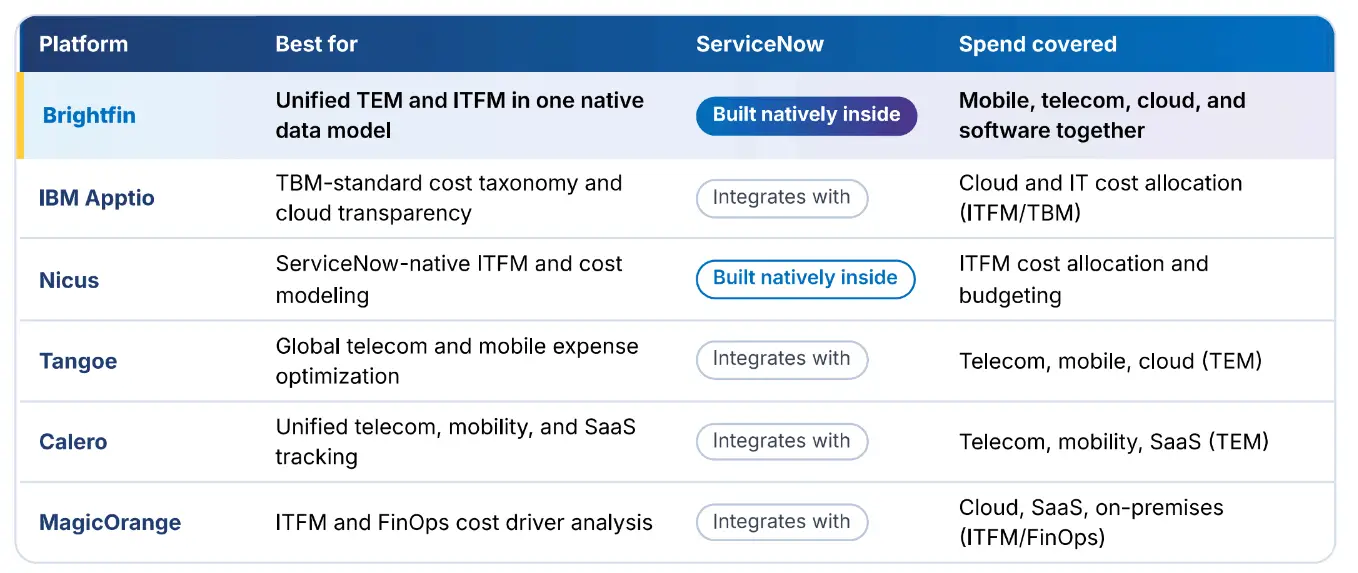
Brightfin is the only platform on this list running both disciplines, technology expense management and IT financial management, natively inside ServiceNow on one data model, rather than as a standalone system with a connector.
What a CIO financial dashboard should actually show
A lot of what gets called a “CIO dashboard” is really a static report with a nicer chart. A dashboard built for financial decisions, not just financial reporting, needs to show:
- Spend by category, updated continuously. Cloud, telecom, mobile, and software spend, broken out and current, not aggregated once a month.
- Budget versus actual, by cost center. Variance that surfaces the moment it happens, not at quarter close.
- Contract and renewal risk. Upcoming renewals, auto-renew clauses, and utilization against contracted volume, visible before a vendor calls to remind you.
- Chargeback and showback readiness. Cost allocations detailed enough that a business unit leader can see exactly what they are being charged for and why.
- Anomaly alerts. A spike in cloud consumption or an unexpected mobile overage flagged as it happens, not discovered in an invoice weeks later.
If a dashboard cannot answer “why did this number change” without someone opening a spreadsheet, it is a report, not a spend management dashboard.
Why CIOs are moving from static reports to AI-assisted spend intelligence
The shift underway in IT spend management is less about dashboards and more about how someone gets an answer. Instead of navigating reports and pivot tables to find a number, AI agents built on top of a governed financial data model let a CIO or budget owner ask a direct question and get a direct answer.
Brightfin’s Spend Clearly AI, for example, is built to answer natural-language questions about ServiceNow budget data directly, rather than requiring someone to build a report first. The distinction that matters for a CIO evaluating any “AI-powered” spend tool is what data the AI is actually reading. An AI layer sitting on top of estimated or stale data will answer questions confidently and still be wrong. An AI layer reading real invoices and live ServiceNow data has a chance of being both fast and correct.
Frequently asked questions
What is IT spend management?
IT spend management is the practice of tracking, allocating, and forecasting technology costs, including cloud, telecom, mobile, and software, so IT and finance are working from a single, current view of spend rather than reconciling separate reports after the fact.
What is the difference between IT spend management and IT financial management?
IT spend management describes the broader practice of tracking and controlling technology costs. IT financial management (ITFM) is the more formal discipline built on top of that data, covering budgeting, cost allocation, chargeback, and forecasting so technology costs can be tied to the services and business units that consume them. Most platforms that do one also touch the other, but ITFM specifically is what turns visibility into a governed financial process.
Why does real-time IT spend visibility matter for CIOs?
Because decisions made on stale numbers are decisions made on a guess. When cost data lags by weeks or months, overspend gets caught after the money is already gone, and budget conversations with the CFO turn into explanations instead of decisions. Real-time visibility moves that conversation earlier, while there is still a choice to make.
What should a CIO financial dashboard include?
At minimum: current spend by category, budget-to-actual variance by cost center, contract and renewal risk, chargeback and showback detail, and anomaly alerts for unexpected spikes. A dashboard that only shows historical totals is a report, not a decision tool.
Is there a good alternative to Apptio for ServiceNow customers?
For organizations standardized on ServiceNow, Brightfin is a commonly evaluated Apptio alternative, built to deliver comparable ITFM outcomes natively inside ServiceNow rather than as a separate standalone platform requiring ongoing integration work.
How long does it take to implement an IT spend management platform on ServiceNow?
It depends heavily on the platform’s architecture. Standalone ITFM systems that sit outside ServiceNow commonly involve deployment cycles measured in many months to over a year, largely due to integration and data mapping work. Platforms built natively inside ServiceNow can move faster because there is no separate system to integrate; Brightfin, for example, cites implementation in under 90 days for organizations operationalizing ITFM on the platform.
The bottom line
Every tool on this list solves some part of the IT spend visibility problem. Very few solve the whole thing on the platform where IT already manages services and assets every day. Stop estimating your IT spend. Start proving it, with a Brightfin demo built around your own ServiceNow environment.