
Table of Contents


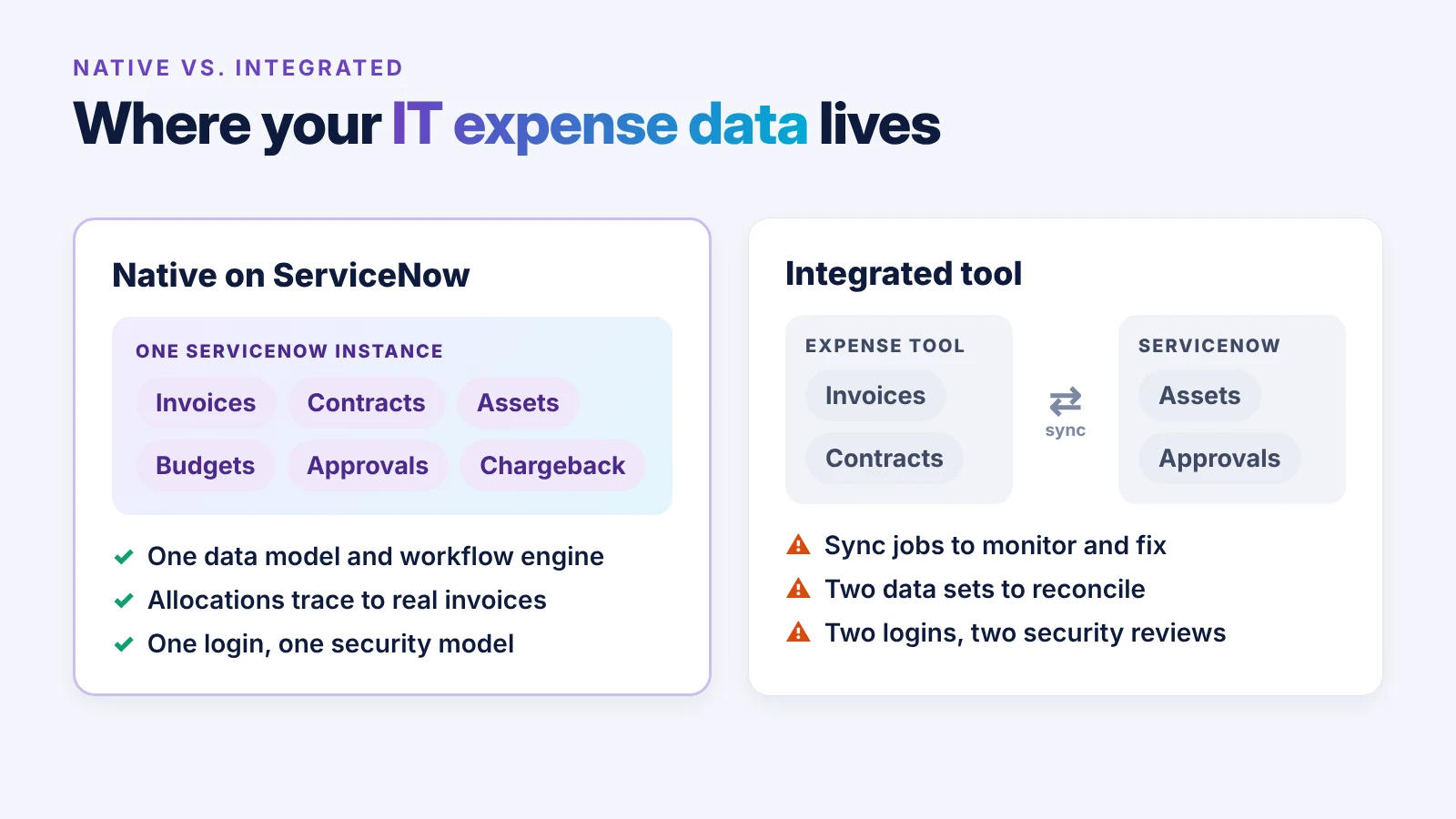
Choosing between IT expense platforms for ServiceNow comes down to one question: where will your cost data live? When invoices, contracts, assets, and budgets sit inside ServiceNow, your team reconciles less and governs more. When they sit in a separate tool, however, you add a portal, a sync job, and another month-end scramble.
Most IT expense programs fail in a predictable way. Invoice data stays split across carriers and cloud vendors. Meanwhile, allocations live in spreadsheets nobody trusts. As a result, the IT finance team spends weeks reconciling numbers instead of governing spend.
This guide ranks six IT expense platforms on ServiceNow alignment, workflow automation, and spend coverage. It also flags the tradeoffs, so you can build a shortlist that holds up in front of your CFO.
Quick guide: the top picks at a glance
- Brightfin: Best overall for ServiceNow-centric enterprises that govern telecom, mobile, and cloud spend in one native data model.
- Tangoe: Broad telecom, mobile, and cloud coverage, plus a large global provider network and managed services.
- Sakon: Telecom expense management paired with built-in AP automation and vendor payments.
- Zylo: SaaS and AI spend discovery, license optimization, and renewal support.
- IBM Apptio: IT financial management modeling built on the TBM framework.
- ServiceNow Financial Management: Native budgeting and cost transparency for a platform-only approach.
How we evaluated these IT expense platforms
A feature checklist won’t tell you much on its own. So we weighted six criteria that decide how much manual work your team still carries after go-live.
- ServiceNow integration depth: Does the IT expense platform run natively in ServiceNow, or rely on an integration and a separate portal?
- Workflow automation: Can it automate ingestion, validation, approvals, disputes, and allocation without manual handoffs?
- Spend coverage: Does it cover telecom, mobile, cloud, and SaaS in one view, or leave gaps you fill with other tools?
- Financial governance: Can you run showback and chargeback, and also produce audit-ready reports that tie consumption to cost?
- AI and analytics: Does AI work on your actual invoices and contracts, for example by flagging errors before payment?
- Managed services: Does the vendor also handle invoice processing, carrier disputes, and ongoing optimization, or is it software only?
The 6 best IT expense platforms for ServiceNow, reviewed
Each review below covers what the IT expense platform does well, how it works with ServiceNow, and what to check before you sign.
1. Brightfin: best overall IT expense platform for ServiceNow
When expense data lives in one system and financial workflows live in another, the gap fills with spreadsheets. Brightfin closes that gap because it is built natively on ServiceNow and holds the Built on Now designation. As a result, every invoice, contract, asset record, and budget line connects in a single budget-to-billing data model.
Brightfin also automates the invoice lifecycle with the ServiceNow workflow engine, from ingestion and validation to disputes and payment. Your team doesn’t need a separate interface or approval chain. In other words, the same data behind your ITSM and CMDB also drives your IT financial management.
Coverage is the other differentiator. Telecom expense management, cloud expense management, and mobility all run on the same IT expense platform inside ServiceNow, with one allocation logic. Brightfin reports that ITFM customers see 20 to 40 percent better cost visibility and 30 percent faster planning cycles.
Key features
- Budget-to-billing data model: Contracts, invoices, inventory, and budgets share one record in ServiceNow, so every allocation traces back to a real invoice.
- Spend Clearly AI: AI reads invoices, spots anomalies, and answers spend questions in plain language. It finishes in seconds a review that takes nearly 20 minutes by hand.
- Showback and chargeback: Consumption-based logic allocates costs to business units, while each statement explains the cost drivers behind it.
- Cross-domain coverage: Telecom, mobile, and cloud spend roll up into one view, so you see the full bill of IT without switching tools.
- Managed services: Brightfin’s team handles disputes, negotiations, and optimization, and the company cites a 20 to 30 percent average cost reduction.
Pros and cons
Pros:
- Native on ServiceNow, so ITSM and IT expense governance share one data model, one workflow engine, and one interface.
- Covers telecom, mobile, cloud, and ITFM together, which reduces the number of point solutions you manage.
- AI works on your own invoices and contracts, so reviews move faster and errors surface before payment.
Cons:
- Its value is greatest inside ServiceNow, so teams on other platforms should ask about deployment options first.
- A full rollout across all four domains takes scoping and data migration, especially in complex multi-carrier estates.
- Teams new to unified IT expense management may need dedicated onboarding time.
2. Tangoe: telecom-rooted coverage with global reach
Tangoe One covers telecom, mobile, cloud, and SaaS expense management. According to its website, Tangoe connects to more than 400 providers and processes about 370,000 invoices a month. It also supports 206 countries and territories, and it pioneered TEM more than 25 years ago.
For ServiceNow customers, Tangoe offers an API-based integration, while the core expense platform runs as a separate hosted service. In addition, managed services cover invoice processing, disputes, and advisory work.
Key features
- Global provider network: More than 400 provider integrations support multinational estates across many currencies and languages.
- Tangoe AI Assistant: Users ask questions about expense data in plain language.
- Managed and advisory services: Tangoe’s team also handles invoice processing, dispute management, and advisory projects.
Pros and cons
Pros:
- Deep global reach, with support for 19 languages, according to Tangoe.
- A long track record in telecom expense management.
- Managed services sit alongside the software, so lean teams get extra hands.
Cons:
- Tangoe runs outside ServiceNow, so expense data moves through an integration rather than living in your instance.
- Two systems also mean two places to manage access, workflows, and reporting.
3. Sakon: telecom expense management with AP automation
Sakon pairs telecom expense management with accounts payable automation. The platform validates carrier invoices, routes them for approval, and then pays vendors on its own payment rails. Sakon supports virtual cards, ACH, eCheck, and check in more than 20 currencies, and it reports over $7 billion in spend under management.
Sakon also offers Telecom Connect apps in the ServiceNow Store for mobile and network inventory, which it describes as Built on Now certified. Its expense and payment processing, however, runs on Sakon’s own platform rather than inside ServiceNow.
Key features
- Built-in AP automation: Sakon pays vendors directly in more than 20 currencies, so many payments become one workflow.
- Telecom AI: It surfaces unused services and circuits and can start disconnects, with optional approvals.
- Chargeback with ERP integration: Telecom costs flow to business units through integrations with major accounting platforms.
Pros and cons
Pros:
- Invoice processing and vendor payment live in one workflow.
- Store apps bring telecom inventory and workflows into your instance.
- Multi-currency payments suit multinational telecom footprints.
Cons:
- The focus is telecom and AP, so cloud spend and ITFM-style cost modeling sit outside its core.
- Expense data lives on Sakon’s platform and syncs to ServiceNow, so you still manage two systems.
4. Zylo: SaaS and AI spend discovery
Zylo calls itself the system of record for SaaS and AI spend. It discovers applications from finance, AP, and expense data, plus SSO and other connectors, which helps surface shadow IT. Zylo also reports a benchmark dataset of more than $100 billion in SaaS, cloud, and AI spend.
Its Clarity AI takes plain-language requests and can build and run workflows. Gartner named Zylo a Leader in the Magic Quadrant for SaaS Management Platforms in 2024, 2025, and 2026.
Key features
- SaaS discovery: Continuous discovery and categorization of apps, including unsanctioned tools.
- Clarity AI: Natural-language questions and workflow automation, although consequential changes need sign-off.
- License optimization: Unused licenses surface early, so teams can reclaim seats before renewal.
Pros and cons
Pros:
- Strong visibility into SaaS and AI tools that slip past procurement.
- Benchmark data gives renewal negotiations useful context.
- Recognized by Gartner as a Leader three years in a row.
Cons:
- SaaS and AI are the focus, so telecom, mobile, and network expense sit outside its core coverage.
- As a standalone SaaS expense platform, Zylo connects to ServiceNow for user and license usage data.
- Its published materials don’t describe showback or chargeback across business units.
5. IBM Apptio: ITFM modeling built on TBM
Apptio, founded in 2007 and part of IBM since 2023, builds IT financial management software around the Technology Business Management (TBM) framework. It turns operational and financial data into cost models, allocation logic, and planning scenarios. In addition, IBM Cloudability extends coverage into cloud cost management and FinOps.
Apptio says it ingests data from more than 350 source systems. Forrester also named it a Leader in The Forrester Wave: IT Financial Management Software, Q2 2026.
Key features
- TBM cost modeling: Maps spend to infrastructure, applications, and services using the TBM taxonomy.
- IBM Cloudability: Multi-cloud cost visibility and commitment management across AWS, Azure, and Google Cloud.
- Planning and forecasting: Budgeting, scenario modeling, and variance analysis for IT finance teams.
Pros and cons
Pros:
- A mature TBM method that large IT finance teams already know.
- Broad data ingestion cuts manual collection for cost transparency work.
- Cloudability adds FinOps depth for multi-cloud estates.
Cons:
- Apptio runs on its own platform and integrates with ServiceNow, so IT expense data and ITSM workflows live apart.
- Its materials focus on ITFM and cloud cost rather than carrier invoices, so telecom-heavy teams may need another tool.
- TBM models take upfront work to map sources and fit the taxonomy to your structure.
6. ServiceNow Financial Management: native budgeting and cost transparency
ServiceNow’s own Financial Management capability, part of Strategic Portfolio Management, covers financial planning, cost modeling, and cost transparency. For teams that already run ITSM, ITOM, and ITAM on ServiceNow, it adds budgeting and allocation without another vendor.
It works best when you want a platform-only approach to IT finance. However, ServiceNow’s published materials don’t describe telecom, mobile, or cloud invoice processing, so you may still need an IT expense platform alongside it.
Key features
- Native data access: Cost models draw directly on CMDB, ITSM, and ITAM records.
- Financial planning: Budget creation, tracking, and variance analysis inside ServiceNow.
- Cost transparency: Allocation rules connect IT costs to services and business units.
Pros and cons
Pros:
- No external platform to sync, which suits a ServiceNow-only architecture.
- Service-level cost views come straight from CMDB data.
- Existing customers may face less procurement effort.
Cons:
- Invoice validation, disputes, and carrier audits fall outside its published scope.
- Cost models depend on clean CMDB and contract data, so setup may need data preparation first.
- Managed services for invoice audits and carrier negotiations would come from a partner instead.
IT expense platforms for ServiceNow compared side by side
Here’s how each IT expense platform works with ServiceNow, what it covers, and how it handles allocation.
| Platform | How it works with ServiceNow | Main spend focus | Allocation and chargeback |
|---|---|---|---|
| Brightfin | Built natively (Built on Now) | Telecom, mobile, cloud, ITFM | Automated showback and chargeback |
| Tangoe | API integration with a separate hosted platform | Telecom, mobile, cloud, SaaS | Expense allocation within Tangoe |
| Sakon | Store apps for telecom inventory; expense runs on Sakon | Telecom and AP automation | Chargeback with ERP integration |
| Zylo | Integration for user and license usage data | SaaS and AI | Not a published focus |
| IBM Apptio | Separate platform with integrations | ITFM and cloud | TBM-based cost allocation |
| ServiceNow Financial Management | Native module | IT budgets and cost models | Allocation rules and cost transparency |
How does workflow automation affect IT expense accuracy?
Manual invoice processing adds errors at every handoff. Invoices arrive from dozens of carriers in different formats. Then someone normalizes the data, checks charges against contracts, routes exceptions, and allocates costs. Each step is a place where mistakes compound.
Automated workflows remove those handoffs. On a native IT expense platform, ServiceNow handles ingestion, validation, dispute routing, and allocation alongside your tickets and assets. As a result, closes move faster, disputes drop, and each allocation traces back to verified source data.
The stakes keep rising, too. Gartner forecasts worldwide IT spending of $6.37 trillion in 2026, up 14.2 percent. With budgets growing that fast, manual reconciliation simply can’t keep pace.
What should you evaluate first in a ServiceNow IT expense platform?
Start with how the IT expense platform connects to your ServiceNow instance. An integration and a natively built app are different things. Integrations move data between two systems on a schedule, which adds latency, sync failures, and a second interface. Native apps, by contrast, use the ServiceNow data model, workflows, and security controls.
Next, look at domain coverage. Many tools specialize in one category, such as telecom, SaaS, or cloud. If you manage all three, a specialist leaves gaps that you fill with more vendors or spreadsheets. By comparison, one data model with unified chargeback logic keeps governance simple.
Finally, weigh operational support. Managed services for invoice audits, carrier disputes, and contract benchmarking keep savings coming after go-live. That is why Brightfin pairs managed services with its native platform.
Why Brightfin leads for ServiceNow-centric teams
Most IT expense programs stall in the gap between knowing what you spend and controlling it. Brightfin closes that gap because its IT expense platform runs the full financial lifecycle inside the ServiceNow environment your team already uses.
Invoices, contracts, assets, budgets, and chargebacks share one system. So there’s no sync job to troubleshoot and no separate reporting layer to reconcile. Your chargeback reports, budget variances, and savings recommendations all draw from the same verified source.
Ready to stop reconciling spreadsheets and start governing IT spend with numbers you can defend? See Brightfin in action.
FAQs about IT expense platforms for ServiceNow
What is an IT expense management platform?
It’s software that centralizes invoice processing, cost allocation, and reporting for technology spend such as telecom, mobile, cloud, and SaaS. Brightfin’s IT expense platform runs these workflows inside ServiceNow, so invoices connect directly to budgets and business units.
Which IT expense platform runs natively on ServiceNow?
Brightfin is built natively on ServiceNow and holds the Built on Now designation. The ServiceNow Financial Management module is native too, but it focuses on budgets and cost models rather than invoice processing. Other tools on this list connect through integrations or Store apps.
Why does native ServiceNow operation matter?
A native app uses the ServiceNow data model, workflow engine, and security framework. So your data stays in one system, your team works in one interface, and allocations connect directly to CMDB and ITSM records.
Can Brightfin manage cloud costs alongside telecom and mobile?
Yes. Brightfin covers telecom, mobile, and cloud spend in one budget-to-billing data model. That means you see total IT spend in one view and allocate every cost with consistent logic.
What is IT chargeback, and why does it matter?
IT chargeback bills technology costs back to the business units that consume them. It drives accountability and shows how IT budgets are really used. For example, one Brightfin customer delivered just over $14.8 million in chargeback to Finance on schedule.