
Table of Contents


Accurate IT cost allocation is what turns an IT budget from a black box into a decision-making tool. When business units trust the numbers, they stop fighting the bill and start using it to make better tradeoffs, and IT and finance spend less time defending the model and more time acting on it. That trust breaks down fast once the underlying data is incomplete or the rules go unexplained.
Worldwide IT spending is projected to reach $6.37 trillion in 2026, up 14.2% from the year before, according to Gartner. Budgets at that scale draw scrutiny, and IT financial management (ITFM) tools exist to answer the question every CFO eventually raises: where is the money going, and what is it buying?
For years, Apptio set the standard for that answer. IBM acquired the company in 2023 for roughly $4.6 billion and folded it into a broader enterprise portfolio alongside Turbonomic, Instana, and watsonx. The deal changed who owns the platform, while finance and IT teams kept asking the same question: does a second, standalone system still earn its place, or is there a better way to get the same visibility?
This guide walks through why organizations research Apptio alternatives, what to weigh when comparing options, and where a platform built natively on ServiceNow fits among them.
Why Organizations Look Beyond a Standalone ITFM Tool
Vendor consolidation now sits near the top of the CIO agenda. A January 2026 survey from Gatekeeper found that 68% of technology leaders plan to reduce their vendor count this year, with most targeting a 20% reduction. A dedicated ITFM platform, however well it performs, is one more line in that count.
Deployment experience is a second factor. IBM Apptio holds a solid 4.3-star average across roughly 190 reviews on G2, and reviewers consistently praise its reporting depth and cost transparency. Alongside that praise, the same reviewers raise a demanding initial setup and a steep learning curve often enough to count as a pattern, with data tagging singled out repeatedly as the most time-consuming part of getting the system running.
Architecture explains part of that pattern. A platform built outside ServiceNow needs a way back in. Apptio itself announced expanded ServiceNow interoperability at its 2023 TBM Conference, a sign that connecting the two systems takes ongoing engineering rather than a shared data model from day one. Each export, sync, and reconciliation step is a point where a number can drift from its source before it reaches a budget review.
Apptio remains a well-established product. Fortune 100 companies rely on it, and the Technology Business Management discipline it helped popularize gave finance and IT a common language for tech spend. The calculus today looks different: with cloud, SaaS, and AI workloads pushing IT budgets higher and boards asking harder questions about every platform on the books, more teams are asking whether ITFM needs its own system at all.
Five Factors Worth Weighing in Any ITFM Platform
Comparing options gets easier once you separate the marketing language from the mechanics underneath it. Here’s what to look at directly.
- Architecture and source of truth: Where does the platform keep its data day to day? A separate application maintains its own database and reconciles with your systems on a schedule. A native application reads from the CMDB and CSDM you already run, in real time, with no reconciliation step at all.
- Cost model flexibility:Some platforms ship with a fixed taxonomy your business has to adapt to. Others let the model flex around the CMDB structure your team has already built, so cost categories match how your organization runs day to day rather than how a vendor predefined them.
- Time to value:Enterprise ITFM rollouts on standalone platforms commonly run 6 to 18 months or longer. A platform built inside the ITSM tool your team already administers can go live in weeks, since setup means configuring workflows inside an environment that’s already running.
- Total cost of ownership:License cost is the visible number. Integration work, dedicated administrators, and the ongoing maintenance of a second environment are the numbers that show up later. Add them up before comparing quotes.
- Governance and security footprint: Every standalone platform brings its own vendor relationship, its own access controls, and often its own security review. A platform that lives inside an environment you already govern inherits that governance instead of duplicating it.
Mapping the Market: The Options on the Table
Most organizations evaluating Apptio alternatives are really choosing between three approaches, whether or not they frame it that way.
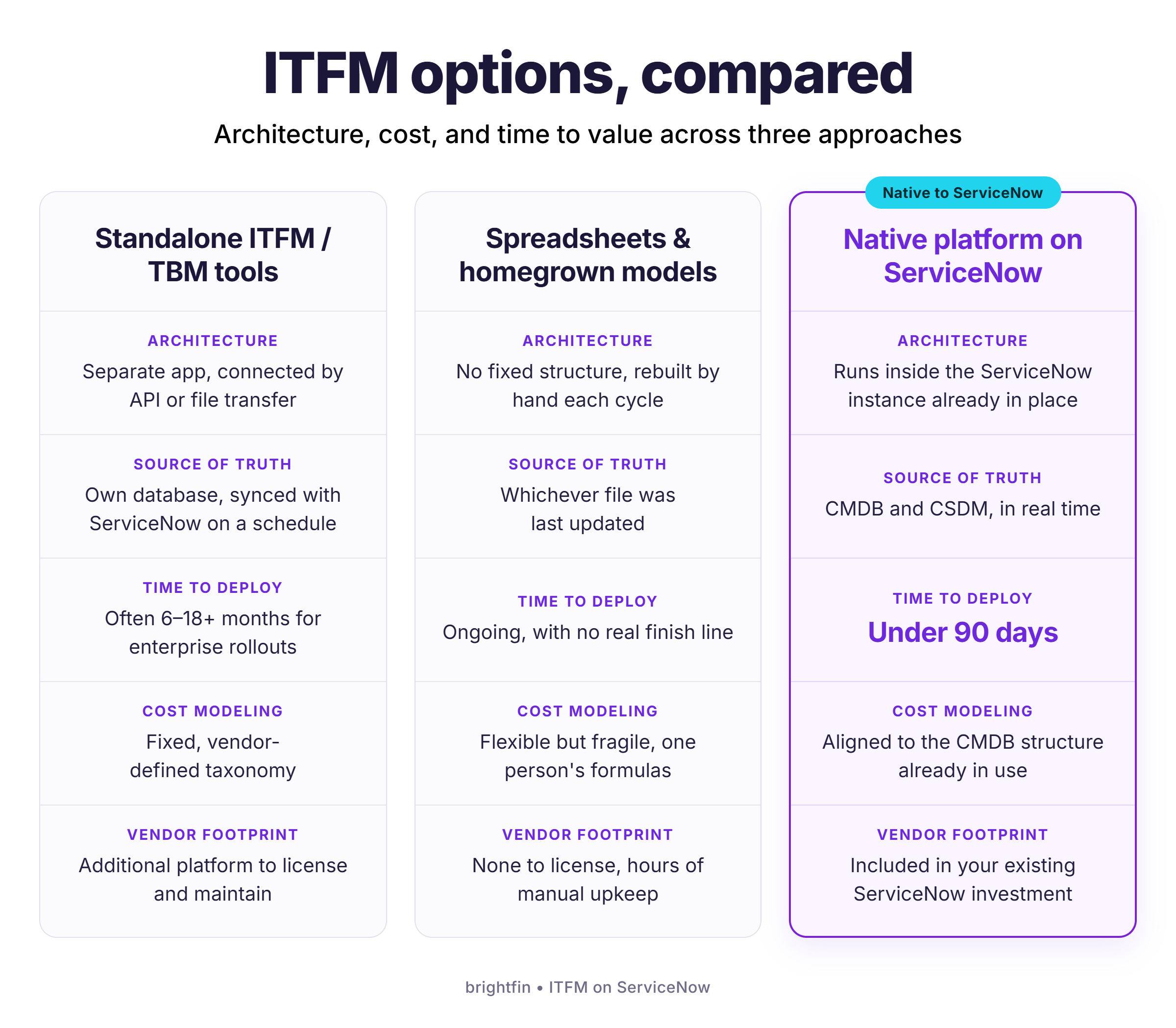
Each path carries a tradeoff. Spreadsheets are free to license, but the manual upkeep and version drift cost time somewhere else. Mature reporting and an established methodology are what a standalone TBM platform delivers, bundled with a second system for your team to run. A native platform asks you to give up a separate license in exchange for a shared data model, an exchange that pays off once your organization already runs ServiceNow at scale.
A Real-World Example: Bringing Three Systems Under One Roof
A global medical technology company operating in more than 190 countries illustrates what this path looks like in practice. Before working with Brightfin, its ITFM practice was split across disconnected pieces: budgeting ran out of spreadsheets, billing was divided between Apptio and outside vendors, and cost modeling had no shared hierarchy across the business, so the underlying systems never exchanged data with each other.
Working with Brightfin, the company brought its ITFM practice onto ServiceNow through a phased rollout, starting with budgeting, moving next to billing, and finishing with cost modeling, rather than a single high-risk cutover. Billing moved off Apptio into a ServiceNow-native workflow that surfaced cost-recovery gaps and fed clean files directly into SAP. IT and finance now work from one real-time source rather than reconciling separate systems.
Questions Worth Asking Before You Decide
Does replacing a standalone platform mean losing functionality? Functionality carries over; what changes is where it runs. Cost transparency, budgeting, and chargeback move onto the same CMDB and CSDM data your IT team already maintains, so reporting draws from a live record instead of a periodically refreshed copy.
Do organizations need to convert everything at once? A phased approach is the norm. Budgeting, billing, and cost modeling can move in stages, so the two environments coexist only as long as necessary and the whole project never rides on a single cutover date.
Is the comparison really Brightfin versus Apptio specifically? The comparison that matters is architectural: a platform bolted onto ServiceNow versus one built inside it. That holds whether the alternative under evaluation is Apptio, another standalone TBM tool, or a cost model held together with spreadsheets and tribal knowledge.
What does “native” mean in practice? A native application runs inside your existing ServiceNow instance, using its CMDB and CSDM data, its existing logins, and its existing security and governance policies. The result is one database to reconcile and one environment for the security team to review.
Where to Go From Here
Researching Apptio alternatives usually starts with a specific frustration: a renewal invoice, a budgeting season that took longer than it should have, or a board asking why IT runs three systems that don’t share data. Whatever prompted the search, the underlying decision is the same one outlined above: architecture, cost model flexibility, deployment time, total cost of ownership, and governance.
Brightfin brings cost transparency, budgeting, and chargeback natively into the ServiceNow instance your organization already runs. Customers moving their ITFM practice onto the platform report cutting software spend by 30–50%, reducing transition and implementation effort by up to 80%, and generating roughly 200% ROI compared with a standalone investment.