

Table of Contents


Ask a university IT leader what it costs to run the learning platform behind every course, and the answer usually starts with a pause.
Not because nobody tracks spend. Universities track spend carefully. The pause happens because the spend lives in the general ledger, sorted by account and department, and the question is about a service. Salaries, software maintenance, contracted services, and hosting all show up as clean line items. What none of them show is the true cost of IT services like research computing, student systems, or campus Wi-Fi.
For one major U.S. research university, that gap had become a real obstacle. This is the story of how its IT organization, working with Brightfin on ServiceNow, moved from labor-intensive cost pulls to a cost model that shows the full cost of every service, and how that clarity is now shaping the way IT gets funded.
Watch the story in 72 seconds:
The question every service-based IT organization eventually gets
Higher education IT runs on services. Classrooms, labs, research centers, and administrative offices all depend on them, and leadership increasingly wants to fund, prioritize, and measure IT the same way: service by service.
Before partnering with Brightfin, the university could not determine the full cost of delivering any of its service offerings. That made it difficult to manage resources effectively, communicate financial data clearly to leadership, and allocate funds strategically. Organizational changes compounded the problem, and the processes that did exist were labor-intensive and lacked the detail needed for strategic decisions.
In practice, that looked like this:
- No full cost for any service offering. Leadership could see what was spent, but not what each service actually cost to deliver.
- Manual, labor-intensive reporting. Every new question meant another round of pulling and assembling data by hand.
- A baseline that kept moving. Organizational changes reshuffled ownership and made prior numbers harder to compare.
- Spend that was hard to explain. Without service-level detail, conversations with leadership stayed general when they needed to be specific.
Why the ledger cannot answer a service question
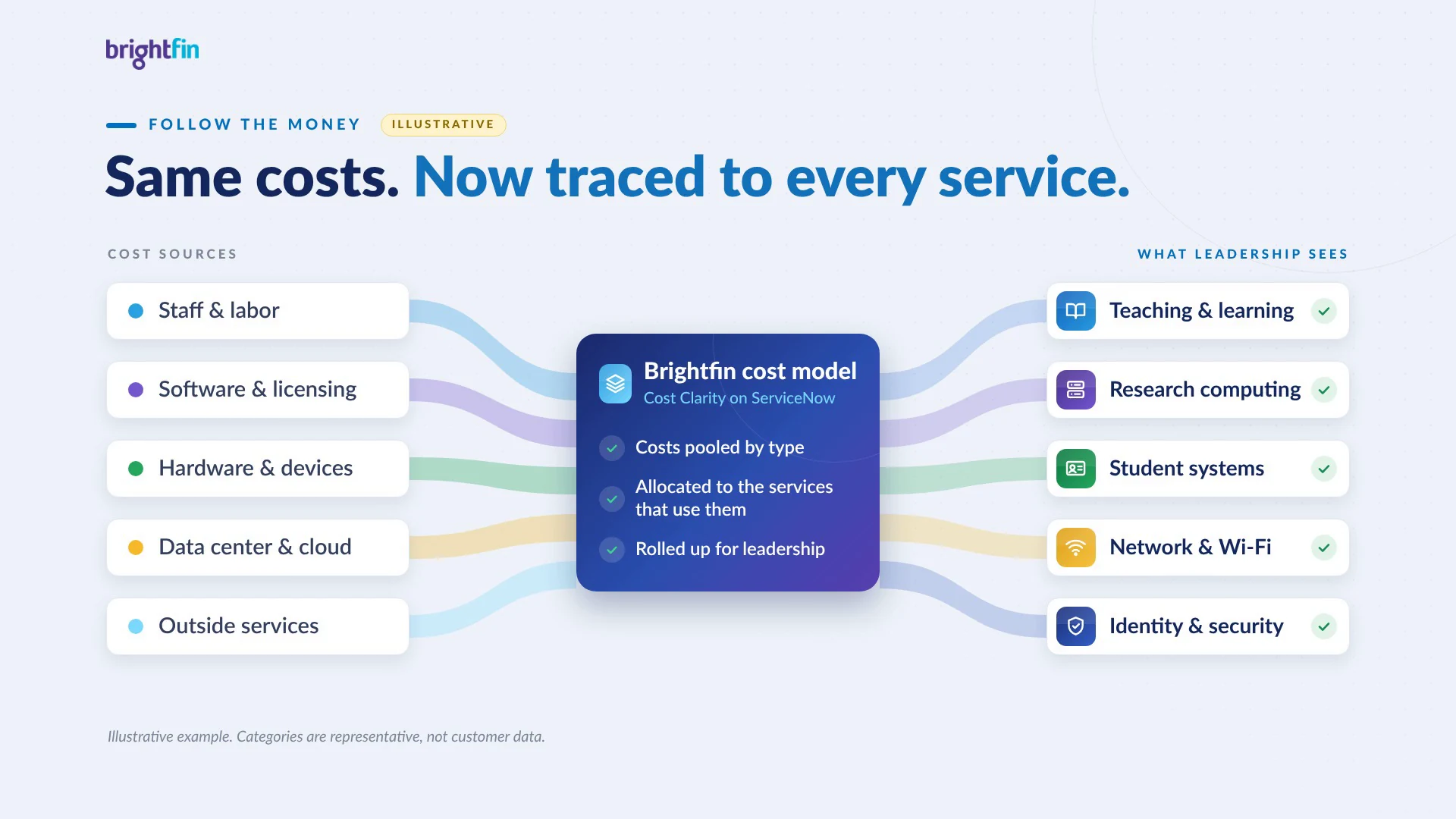
This is not a university problem. It is a structural one. A general ledger is built to record transactions by account and cost center. Leaders ask about services. Bridging the two takes a cost model: a way to pool costs by type and allocate them to the services that actually consume them, using rules that hold up when someone asks where a number came from.
Without that model, every service cost is a one-off spreadsheet exercise. It takes days, it depends on whoever built it, and it breaks the next time the organization chart changes. That is exactly why IT financial management exists as a discipline, and why where the model lives matters as much as how it is built.
What the university needed
The goal was bigger than a single report. The university needed clarity around service costs, produced in a repeatable, scalable way, so the answer would not have to be rebuilt every cycle. Just as important, it needed room to grow: a way to evolve its cost management practices, gain deeper insight over time, and mature alongside the university’s own goals.
A partnership, not a software install
Rather than simply implementing software, Brightfin worked closely with the university’s team to make sure the ITFM cost model fit its unique services and structure. The work quickly grew into a long-term partnership focused on continuous improvement, and it moved through three stages.
1. Build the cost model.
Brightfin shaped an ITFM cost model on ServiceNow around the university’s own services and departments, not a generic template. Every service offering now has a full cost of delivery behind it.
2. Light up the dashboards.
Intuitive dashboards gave leadership unprecedented visibility into service costs, tracked across departments and service offerings. What used to be a cumbersome, manual process is now on screen.
3. Put the data to work.
With trusted service costs in hand, the university began using them where decisions happen: conversations about funding, KPIs, and success factors.
“The support went above and beyond my expectations.”
University team member, major U.S. research university
What changed: clarity that shapes how IT gets funded
The biggest win was clarity. University leaders can now see what every service costs and track it across departments, without a manual process behind every answer.
That visibility has become instrumental in shaping conversations around transformational efforts, including the creation of a new operating and funding model. The dashboards provide valuable insight into cost allocation, and the university is now able to make informed decisions about funding, KPIs, and success factors. Seeing service costs this clearly is already driving meaningful changes in how resources are allocated across the university.
An evolving journey, not a one-time project
The university does not treat its cost model as finished. It views ITFM as an evolving journey that moves with its business goals, and it is continuing to mature. As it moves to Brightfin’s newest cost model, the next phase focuses on analyzing costs by business capability and exploring trends that turn into predictive insight.
That is where Brightfin managed services come in. Tailored support, training, and dedicated expert hours give the team the resources and expertise to fully optimize the model, address new challenges, and keep improving its cost management practices. Ongoing training and iterative model updates mean the model adapts as business needs change, instead of drifting out of date after the next reorganization.
For any organization comparing ITFM platforms, this is worth weighing carefully. A cost model is only as useful as it is current, and the difference between a model that keeps answering new questions and one that quietly goes stale is often the expertise behind it.
Lessons for IT leaders building a cost-of-service model
- Start with services, not the ledger. Define the services leadership actually asks about, then build the model that maps costs to them.
- Design for repeatability. Organizational change is a given. A model that depends on manual rebuilds will not survive it.
- Put cost data where decisions happen. Dashboards that leaders use in funding conversations do more than reports that arrive after the decision is made.
- Plan for the model to mature. Service costing is the foundation. Business capabilities, trends, and predictive insight come next, and they are easier to reach with expert support alongside.
See the true cost of every service
When leadership needed financial answers it could act on, this university chose clarity. Brightfin built the cost model on ServiceNow and stays alongside it with managed services, so leadership plans with a clear view of what every service costs.
Download the full customer story (PDF) or request a demo to see what Cost Clarity on ServiceNow could show your organization.